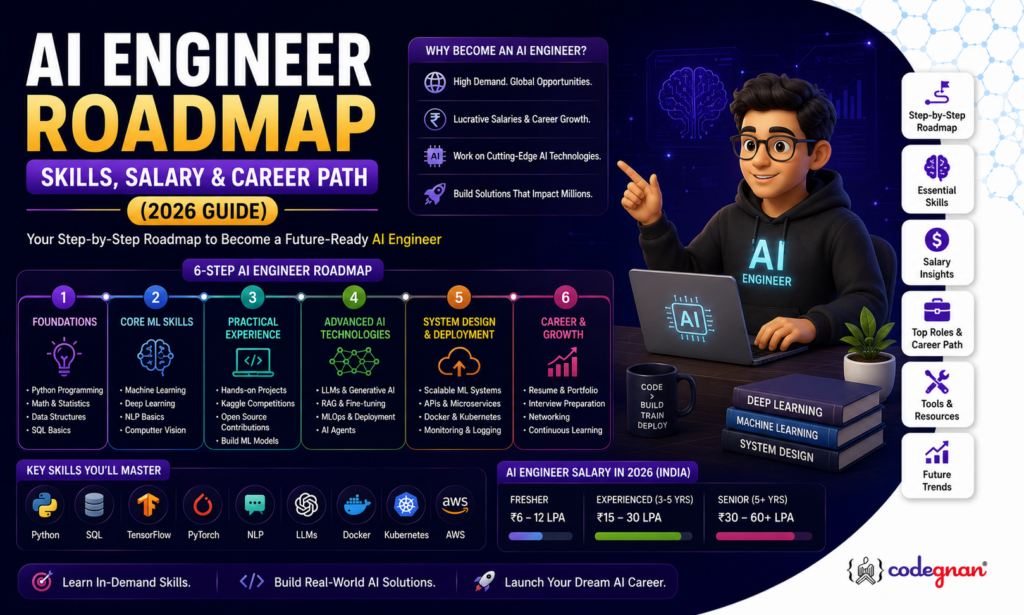





Artificial intelligence has moved from research labs into everyday products, and the professionals who build these systems, AI Engineers, are now among the most sought after tech talent in the world. If you are wondering how to become an AI Engineer in 2026, this guide lays out a complete, step by step roadmap covering programming, mathematics, machine learning, deep learning, generative AI, MLOps, salary expectations, certifications, and career growth. Whether you are a student, a working professional, or a software developer planning a switch, this roadmap will help you plan your learning path with clarity.
Quick Answer: An AI Engineer builds and deploys intelligent systems using Python, machine learning, deep learning, and large language models. The roadmap to becoming one in 2026 covers programming, math, data analysis, ML, deep learning, NLP, LLMs, MLOps, and cloud deployment, typically taking 6 to 18 months depending on your starting point. At Codegnan, learners follow this exact path through structured, project based training.
What Is an AI Engineer?
An AI Engineer is a technology professional who designs, builds, trains, and deploys artificial intelligence systems that solve real world business problems. This includes everything from recommendation engines and fraud detection systems to chatbots, AI agents, and retrieval augmented generation (RAG) applications built on large language models. Unlike a pure researcher, an AI Engineer is deeply focused on production, meaning the models they build actually need to run reliably, scale to real users, and integrate with existing software systems.
The role sits at the intersection of software engineering, data science, and applied machine learning. A typical day might involve writing data pipelines, fine tuning a model, building an API around an LLM, or debugging a deployment issue in a cloud environment. Because AI adoption is accelerating across every industry, from healthcare to finance to retail, the demand for engineers who can take AI from a proof of concept to a working product has never been higher.
Roles & Responsibilities
AI Engineers typically handle a mix of the following responsibilities:
- Collecting, cleaning, and preparing data for training and evaluation
- Selecting and building machine learning or deep learning models suited to the problem
- Fine tuning pre trained models and large language models for specific use cases
- Building retrieval augmented generation pipelines and AI agents
- Writing APIs and backend services to serve models in production
- Setting up MLOps pipelines for continuous training, testing, and deployment
- Monitoring model performance and retraining when accuracy drops
- Collaborating with data scientists, product managers, and software teams to align AI solutions with business goals
AI Engineer vs Machine Learning Engineer
The two roles overlap significantly, but there are meaningful differences. A Machine Learning Engineer usually focuses on building and optimizing traditional ML models such as regression, classification, and clustering systems, along with the infrastructure to train and serve them at scale. An AI Engineer has a broader scope that increasingly includes generative AI, large language models, prompt engineering, and AI agents, often working with pre trained foundation models rather than training everything from scratch. In many companies today, the AI Engineer title has effectively absorbed much of what used to be called applied ML engineering, with an added emphasis on LLM based systems.
AI Engineer vs Data Scientist
Data Scientists spend most of their time exploring data, running statistical analysis, and generating insights that guide business decisions. Their output is often a report, dashboard, or a prototype model. AI Engineers take things further by productionizing these models, wrapping them into scalable services, and ensuring they work reliably in live applications. A useful way to think about it is that Data Scientists ask what the data is telling us, while AI Engineers ask how do we turn that insight into a working system that millions of users can rely on.
AI Engineer vs Data Engineer
Data Engineers build and maintain the pipelines, warehouses, and infrastructure that move and store data reliably. They make sure clean, well structured data is available for downstream use. AI Engineers consume that data to build and deploy intelligent models. Data Engineers focus on data movement and quality, while AI Engineers focus on turning that data into working AI systems. In many teams, these two roles work closely together, and a working knowledge of data engineering concepts is a genuine advantage for any AI Engineer.
Why Choose AI Engineering in 2026?
Industry Demand
AI hiring has continued its sharp climb through 2026. Industry reports point to demand for AI professionals growing by over 40 percent year on year in India alone, driven by enterprises adopting generative AI, automation, and intelligent products across every sector. Globally, AI related job postings have grown several times faster than the overall job market since the early 2020s, and this trend shows no signs of slowing down.
Career Growth
AI Engineering offers one of the fastest compensation growth curves in technology. Engineers who build a strong portfolio, pick up cloud certifications, and specialize in high demand areas like generative AI or MLOps routinely see their pay double or triple within a few years of entering the field. Career progression is also unusually fast compared to traditional software roles, since the talent pool with production grade AI skills is still relatively small.
Job Opportunities
Companies across IT services, product startups, global capability centers, banking, healthcare, and e-commerce are all hiring AI talent. Roles range from AI Engineer and ML Engineer to more specialized titles like NLP Engineer, Generative AI Engineer, Prompt Engineer, Computer Vision Engineer, and MLOps Engineer. This diversity means there is a path for people from many different backgrounds, whether you come from software development, data analysis, or a fresh computer science degree.
Future of AI
The next few years will likely see AI move deeper into agentic systems, where AI does not just answer questions but takes multi step actions on behalf of users. Combined with continued growth in multimodal models, on device AI, and enterprise adoption of retrieval augmented generation, the demand for engineers who understand both the theory and the deployment side of AI is expected to keep climbing well beyond 2026.
AI Engineer Roadmap (Step-by-Step)
This is the core learning path. Each step builds on the previous one, so it is best followed in order, though experienced developers can move faster through the early stages.
Step 1: Learn Programming
Every AI system is, at its core, software. Strong programming fundamentals are non negotiable.
- Python: The primary language for AI and machine learning, thanks to its readability and the massive ecosystem of libraries built around it.
- SQL: Needed to query, filter, and join data stored in relational databases, a skill you will use constantly when preparing training data.
- Git: Version control that lets you track changes to your code and collaborate without overwriting each other’s work.
- GitHub: The platform where you host your code, contribute to open source projects, and build a public portfolio that recruiters actually check.
If you are starting from zero, Codegnan’s Python programming course is designed specifically to build this foundation before moving into AI concepts.
Step 2: Learn Mathematics
Mathematics is what separates engineers who can tune models intelligently from those who only call library functions without understanding what is happening underneath.
- Linear Algebra: Vectors, matrices, and matrix operations, which form the backbone of how neural networks process data.
- Probability: Essential for understanding uncertainty, model predictions, and concepts like Bayesian inference.
- Statistics: Needed to evaluate models, understand distributions, and interpret data correctly.
- Calculus: Derivatives and gradients are the mathematical engine behind how neural networks learn through backpropagation.
- Optimization: Understanding how algorithms like gradient descent minimize error during training.
You do not need a PhD level grasp of these topics, but a solid working understanding will make every subsequent step easier to learn.
Step 3: Data Structures & Algorithms
Even in an AI heavy role, technical interviews and efficient coding both depend on strong DSA fundamentals.
- Arrays: The most basic building block for storing and manipulating data efficiently.
- Linked Lists: Useful for understanding memory management and pointer based structures.
- Trees: Core to many algorithms, including decision trees used directly in machine learning.
- Graphs: Important for understanding relationships in data, used in recommendation systems and network analysis.
- Recursion: A problem solving pattern that shows up repeatedly in algorithm design and even in some model architectures.
Step 4: Data Analysis
Before you can build models, you need to understand and shape the data feeding into them.
- NumPy: The foundational library for numerical computing in Python, used for array operations and mathematical functions.
- Pandas: The go to library for loading, cleaning, and transforming structured data.
- Matplotlib: A core plotting library for visualizing trends and distributions in your data.
- Seaborn: Built on top of Matplotlib, offering more polished statistical visualizations with less code.
- Data Cleaning: The practical skill of handling missing values, duplicates, and inconsistent formatting, which in real projects consumes far more time than model building itself.
Step 5: Machine Learning
This is where you start teaching machines to learn patterns from data.
- Supervised Learning: Training models on labeled data to predict outcomes, the foundation of most practical ML applications.
- Unsupervised Learning: Finding hidden patterns in data without labeled outcomes.
- Regression: Predicting continuous values, such as forecasting prices or demand.
- Classification: Predicting categories, such as spam detection or churn prediction.
- Clustering: Grouping similar data points together, commonly used in customer segmentation.
- Model Evaluation: Measuring accuracy, precision, recall, and other metrics to judge how well a model actually performs.
Codegnan’s Machine Learning course walks through each of these concepts with hands on projects rather than theory alone.
Step 6: Deep Learning
Deep learning powers most of the breakthroughs behind modern AI, from image recognition to language models.
- Neural Networks: The layered structure of interconnected nodes that forms the basis of deep learning.
- CNNs (Convolutional Neural Networks): Specialized for image and visual data processing.
- RNNs (Recurrent Neural Networks): Designed for sequential data such as time series and early language models.
- LSTMs (Long Short Term Memory): An improved version of RNNs that better handles long range dependencies in sequences.
- Transformers: The architecture behind virtually every modern large language model, and arguably the single most important concept to master today.
Step 7: Natural Language Processing (NLP)
NLP is the branch of AI focused on understanding and generating human language.
- Text Processing: Cleaning and preparing raw text for analysis.
- Tokenization: Breaking text into smaller units that models can process.
- Embeddings: Converting words and sentences into numerical vectors that capture meaning.
- Sentiment Analysis: Determining the emotional tone behind a piece of text.
- Named Entity Recognition: Identifying names, places, dates, and other structured information within text.
Step 8: Large Language Models (LLMs)
This is the fastest growing and currently the most in demand skill area in AI Engineering.
- Prompt Engineering: Crafting inputs that reliably guide LLMs to produce accurate, useful outputs.
- Fine Tuning: Adapting a pre trained model to perform well on a specific task or domain.
- Retrieval Augmented Generation (RAG): Combining LLMs with external knowledge bases so responses are grounded in accurate, up to date information.
- AI Agents: Systems that use LLMs to plan and execute multi step tasks, often calling external tools or APIs along the way.
- Vector Databases: Specialized databases like Pinecone or ChromaDB that store embeddings for fast similarity search, a core component of RAG systems.
- LangChain: A popular framework for building applications powered by LLMs, chaining together prompts, tools, and memory.
- LlamaIndex: A framework focused specifically on connecting LLMs to your own data sources for retrieval based applications.
Industry data consistently shows generative AI and LLM skills commanding the steepest salary premiums in the market right now, making this step particularly valuable for career growth. Codegnan’s Generative AI and LLM course covers this entire stack with real project builds.
Step 9: Computer Vision
For engineers interested in working with images and video, computer vision is a natural specialization.
- OpenCV: The most widely used library for image processing and computer vision tasks.
- Image Classification: Teaching models to correctly label what an image contains.
- Object Detection: Identifying and locating multiple objects within an image or video frame.
- Image Segmentation: Breaking an image into meaningful regions, used heavily in medical imaging and autonomous vehicles.
Step 10: MLOps
Building a model is only half the job. MLOps is what keeps AI systems running reliably in production.
- ML Pipelines: Automated workflows that handle data ingestion, training, and deployment consistently.
- Docker: Packaging applications and their dependencies into portable containers.
- Kubernetes: Orchestrating and scaling containerized applications across clusters.
- MLflow: A tool for tracking experiments, versioning models, and managing the ML lifecycle.
- CI/CD: Continuous integration and deployment pipelines that automate testing and release of updated models.
- Model Deployment: Making trained models accessible through APIs or applications that real users can interact with.
Step 11: Cloud Platforms
Almost every production AI system runs on the cloud, making at least one platform essential to learn.
- AWS: The largest cloud provider, with a full suite of AI and ML services including SageMaker.
- Azure: Microsoft’s cloud platform, widely used in enterprise environments and tightly integrated with OpenAI models.
- Google Cloud: Known for strong AI infrastructure, including Vertex AI and its own family of foundation models.
Step 12: AI Deployment
Finally, you need the skills to expose your models as usable applications.
- FastAPI: A modern, high performance Python framework for building APIs, extremely popular for serving ML models.
- Flask: A lightweight Python web framework often used for simpler model deployment tasks.
- Streamlit: A tool for quickly building interactive web apps around your models, ideal for demos and internal tools.
- Gradio: Similar to Streamlit but particularly popular for creating quick interfaces around machine learning and LLM demos.
- REST APIs: The standard way applications communicate with your deployed models over the internet.
AI Engineer Learning Timeline
| Timeline | Skills to Learn |
|---|---|
| Month 1 to 2 | Python, SQL, Git, GitHub, Mathematics, Data Structures and Algorithms |
| Month 3 to 4 | Data Analysis (NumPy, Pandas, Matplotlib, Seaborn), Machine Learning fundamentals |
| Month 5 to 6 | Deep Learning, Neural Networks, CNNs, RNNs, Transformers |
| Month 7 to 8 | NLP, Embeddings, Large Language Models, Prompt Engineering, RAG |
| Month 9 to 10 | AI Agents, LangChain, LlamaIndex, Vector Databases, Computer Vision basics |
| Month 11 to 12 | MLOps, Docker, Kubernetes, Cloud Platforms, Model Deployment |
| Month 13 onward | Portfolio projects, certifications, interview preparation, job applications |
This timeline assumes consistent daily study. Working professionals with existing programming experience often compress this into 6 to 8 months, while complete beginners may need closer to 18 months for a thorough foundation. Structured programs like Codegnan’s AI Engineering course are built to help learners follow this exact timeline with mentor support and real projects rather than figuring it out alone.
AI Tech Stack
| Category | Tools |
|---|---|
| Programming | Python, SQL |
| Data Analysis | NumPy, Pandas, Matplotlib, Seaborn |
| Machine Learning | Scikit-learn, XGBoost |
| Deep Learning | TensorFlow, PyTorch, Keras |
| NLP | spaCy, NLTK, Hugging Face Transformers |
| LLM Frameworks | LangChain, LlamaIndex |
| Vector Databases | Pinecone, ChromaDB, Weaviate, FAISS |
| MLOps | MLflow, Docker, Kubernetes, Airflow, Kubeflow |
| Cloud | AWS, Azure, Google Cloud |
| Deployment | FastAPI, Flask, Streamlit, Gradio |
Essential AI Engineer Skills
Technical Skills
Strong Python programming, a solid grasp of mathematics and statistics, hands on experience with machine learning and deep learning frameworks, familiarity with large language models and prompt engineering, working knowledge of MLOps and cloud deployment, and the ability to write clean, production ready code.
Soft Skills
Problem solving and analytical thinking, clear communication of technical concepts to non technical stakeholders, curiosity and a habit of continuous learning given how quickly this field evolves, patience for debugging and experimentation, and the ability to work effectively within cross functional teams.
Business Skills
Understanding how AI solutions tie back to business goals and return on investment, basic project management to plan and deliver AI initiatives on time, an awareness of responsible AI and ethical considerations, and the ability to translate business problems into technical requirements that a model can actually solve.
Best AI Projects
Building projects is the single most important thing you can do to prove your skills to employers. Here are project ideas organized by difficulty.
Beginner
- Chatbot: Build a rule based or simple ML powered chatbot that can answer common questions.
- Spam Detector: A classification model that flags spam emails or messages using NLP techniques.
- Movie Recommendation System: A collaborative filtering system that suggests movies based on user preferences.
Intermediate
- Resume Parser: An NLP tool that extracts structured information like skills and experience from resumes automatically.
- Image Classifier: A CNN based model that categorizes images into predefined classes.
- Sentiment Analysis: A model that analyzes product reviews or social media posts to gauge public opinion.
Advanced
- AI Copilot: A tool that assists users with tasks in real time, similar to coding assistants or writing tools.
- RAG Chatbot: A chatbot that retrieves information from a custom knowledge base before generating grounded, accurate answers.
- AI Agent: A system that can plan and execute multi step tasks autonomously using LLMs and external tools.
- Voice Assistant: An application that combines speech recognition, NLP, and text to speech to interact with users verbally.
- Document Q&A System: A tool that lets users upload documents and ask natural language questions about their content.
Codegnan structures its AI and Data Science programs around exactly this kind of project progression, so learners graduate with a portfolio, not just certificates.
AI Certifications
Certifications alone will not get you hired, but paired with real projects, they strengthen your resume and validate your skills to recruiters.
- Google: Google Cloud Professional Machine Learning Engineer and various Generative AI certifications through Google Cloud Skills Boost.
- Microsoft: Microsoft Certified Azure AI Engineer Associate, a strong choice for those targeting enterprise environments.
- AWS: AWS Certified Machine Learning Specialty, widely recognized among employers using AWS infrastructure.
- IBM: IBM AI Engineering Professional Certificate, covering machine learning and deep learning fundamentals.
- DeepLearning.AI: Deep Learning Specialization and Generative AI courses created by Andrew Ng, considered some of the most respected foundational credentials in the field.
AI Engineer Salary
Compensation for AI Engineers varies widely based on experience, location, company type, and specialization, but it consistently ranks among the highest paying roles in technology.
India
Entry level AI Engineers in India typically start between 5.8 and 8 LPA at IT services companies, while product companies and startups often pay 8 to 15 LPA for freshers with demonstrated project experience in generative AI or LLMs. Mid level engineers with a few years of experience generally earn between 15 and 30 LPA. Senior engineers, AI architects, and generative AI specialists at top product companies and global capability centers can earn 50 to 80 LPA or more, with principal and research roles at global firms going higher still. Bengaluru consistently pays the highest AI engineering salaries in India, followed by Hyderabad and Gurgaon.
USA
In the United States, AI Engineer salaries in 2026 average between roughly 145,000 and 185,000 dollars per year in base pay, with total compensation including bonus and equity often reaching 200,000 to 240,000 dollars when averaged across experience levels. Entry level roles typically start around 100,000 to 130,000 dollars, while senior and staff level engineers at major tech companies can see total compensation well above 300,000 dollars, particularly at companies competing aggressively for generative AI talent.
Europe
European salaries for AI Engineers vary significantly by country, with the UK, Germany, and the Netherlands generally offering the highest pay in the region. Mid level engineers in major European tech hubs typically earn the equivalent of 60,000 to 100,000 euros annually, with senior specialists in generative AI and MLOps commanding a premium over general ML roles, similar to the trend seen in both the US and Indian markets.
Experience-wise Salary
| Experience | Average Salary (India) |
|---|---|
| Fresher (0 to 1 year) | 5.8 to 8 LPA |
| Junior (1 to 3 years) | 8 to 15 LPA |
| Mid level (3 to 6 years) | 15 to 30 LPA |
| Senior (6 to 10 years) | 30 to 55 LPA |
| Lead or Architect (10+ years) | 55 to 80 LPA and above |
Skills in generative AI, LLM fine tuning, MLOps, and AI agents consistently command a significant premium over base AI engineering pay, often 25 to 45 percent higher, across every experience level and region.
AI Engineer Career Path
The typical career progression for an AI Engineer looks like this:
- AI Intern: Entry point for students and recent graduates, focused on learning tools and contributing to small parts of larger projects.
- Junior AI Engineer: Building and testing models under guidance, gradually taking ownership of small features or pipelines.
- AI Engineer: Independently designing, building, and deploying models, owning end to end project components.
- Senior AI Engineer: Leading complex projects, mentoring junior engineers, and making architectural decisions.
- AI Architect: Designing AI systems and infrastructure at an organizational level, setting technical standards across teams.
- Head of AI: Leading AI strategy and teams at a company wide level, bridging technical execution with business direction.
This progression is not strictly linear. Many engineers branch into specialized tracks such as Generative AI Engineer, MLOps Engineer, or AI Research Engineer as their careers develop, often earning premium compensation in these specialized paths.
AI Interview Preparation
Technical Questions
Expect questions on core concepts such as overfitting versus underfitting, bias variance tradeoff, how backpropagation works, and the differences between various model architectures.
Coding Questions
Standard data structures and algorithms questions remain common, alongside Python coding exercises involving data manipulation with Pandas and NumPy.
ML Questions
Be ready to explain how you would approach a given business problem end to end, including data collection, feature engineering, model selection, and evaluation metrics appropriate to the problem.
LLM Questions
Increasingly common in 2026 interviews are questions about prompt engineering strategies, when to use fine tuning versus RAG, how vector databases work, and how to design reliable AI agents.
System Design
Senior roles often include system design questions focused on building scalable ML pipelines, designing a RAG system for a specific use case, or architecting a recommendation engine that can handle millions of users.
Best Resources to Learn AI
- Courses: Structured programs like Codegnan’s AI and Machine Learning courses, along with specialized courses from DeepLearning.AI and Coursera.
- Books: Foundational texts on machine learning and deep learning remain valuable references even as tools evolve.
- YouTube Channels: Channels focused on practical, project based AI tutorials help reinforce concepts learned in structured courses.
- Research Papers: Reading papers on transformer architectures and recent LLM advancements keeps you current with where the field is heading.
- Documentation: Official documentation for PyTorch, TensorFlow, LangChain, and Hugging Face is often the most accurate and up to date resource available.
Common Mistakes Beginners Make
Many beginners jump straight into deep learning and LLMs without building a solid foundation in Python, mathematics, and classical machine learning, which makes advanced concepts far harder to grasp. Others focus entirely on watching tutorials without building projects, leaving them unable to demonstrate real skills in interviews. Skipping data analysis and data cleaning is another common gap, since real world data is rarely as clean as tutorial datasets. Some learners also chase every new tool and framework without going deep on fundamentals, resulting in shallow knowledge across many topics rather than genuine expertise in a few. Finally, many beginners neglect building a public portfolio on GitHub, which is often the first thing recruiters and hiring managers check.
AI Career Opportunities
Beyond the core AI Engineer title, this roadmap opens doors to several related roles:
- AI Engineer: Broad role covering model building, fine tuning, and deployment.
- ML Engineer: Focused on traditional machine learning systems and infrastructure.
- NLP Engineer: Specializes in language understanding and generation systems.
- Computer Vision Engineer: Focused on image and video based AI applications.
- Generative AI Engineer: Specializes in LLMs, RAG systems, and generative applications, currently one of the highest paid specializations in the market.
- Prompt Engineer: Focused on designing and optimizing prompts for reliable LLM outputs.
- AI Research Engineer: Works closer to the cutting edge, often involved in model architecture and experimentation.
- MLOps Engineer: Focused on the infrastructure and pipelines that keep AI systems running reliably in production.
AI Engineer Resume & Portfolio Guide
Your resume should lead with concrete, measurable outcomes rather than a list of tools. Instead of simply listing Python and TensorFlow, describe what you built, the problem it solved, and any measurable impact such as improved accuracy or reduced processing time. Your GitHub portfolio matters just as much as your resume. Include at least three to five well documented projects that show a clear progression in complexity, from a beginner classification project to an advanced RAG based application. Write clear README files explaining your approach, the tools used, and the results achieved. If possible, deploy at least one project as a live demo using Streamlit or Gradio, since a working application makes a far stronger impression than static code alone. Finally, keep your resume tailored to the specific role you are applying for, highlighting the skills and projects most relevant to that job description.
AI Roadmap by Background
For Students
Focus on building strong fundamentals in programming and mathematics during your degree, and use the summer breaks or free semesters to work through machine learning and deep learning projects. Participating in hackathons and open source projects will also strengthen your practical experience well before graduation.
For Working Professionals
If you already have a job, learning part time through structured evening or weekend programs is often the most realistic path. Codegnan’s AI courses for working professionals are designed with flexible schedules in mind, allowing you to build skills without leaving your current role.
For Software Developers
Developers already have the programming foundation, so the fastest path forward is to focus directly on mathematics, machine learning, and deep learning, then move quickly into LLMs and MLOps since these areas build naturally on existing backend and API development skills.
For Data Analysts
Analysts already understand data deeply, so the natural next step is strengthening Python programming skills, followed by machine learning fundamentals and gradually moving into deep learning and generative AI to expand from insight generation into building predictive and generative systems.
FAQs
What does an AI Engineer do?
An AI Engineer designs, builds, and deploys AI systems that learn from data to solve real world problems, ranging from recommendation engines to chatbots and AI agents built on large language models.
How do I become an AI Engineer in 2026?
Start with Python, mathematics, and data structures, move through machine learning and deep learning, then specialize in NLP and large language models before learning MLOps and cloud deployment to build and ship production ready AI systems.
Is Python required for AI Engineering?
Yes. Python is the primary language used across nearly every stage of AI development, from data analysis to model building to deployment, making it essential to master early in your roadmap.
What skills are needed to become an AI Engineer?
Core skills include Python programming, mathematics and statistics, machine learning and deep learning, NLP, large language models, MLOps, and cloud platforms, along with strong problem solving and communication abilities.
How long does it take to become an AI Engineer?
Most learners take between 6 and 18 months depending on their starting point, with working professionals and experienced developers often progressing faster than complete beginners.
What are the best AI projects for beginners?
Strong beginner projects include a chatbot, a spam detector, and a movie recommendation system, since they cover classification, NLP, and recommendation techniques with manageable complexity.
What is the average salary of an AI Engineer?
In India, AI Engineer salaries typically range from 6 LPA for freshers to 80 LPA or more for senior specialists, while in the United States, average total compensation in 2026 generally falls between 180,000 and 240,000 dollars depending on experience and company.
Which AI certifications are most valuable?
Certifications from Google Cloud, Microsoft Azure, AWS, IBM, and DeepLearning.AI are widely recognized by employers and can strengthen your resume when paired with real, demonstrable projects.
What is the difference between an AI Engineer and a Machine Learning Engineer?
Machine Learning Engineers focus primarily on traditional ML models and the infrastructure to train and serve them, while AI Engineers have a broader scope that increasingly includes generative AI, large language models, and AI agents built on pre trained foundation models.
Is AI Engineering a good career in 2026?
Yes. With demand for AI professionals growing over 40 percent year on year in many markets and salaries consistently outpacing traditional software roles, AI Engineering remains one of the strongest career paths in technology heading into 2027 and beyond.
Ready to start your AI Engineering journey? Explore Codegnan’s AI and Data Science programs for structured, project based training that follows this exact roadmap from Python fundamentals to deployment ready large language model applications.