


We’ve trained over 30,000 students and helped many land jobs at top companies across India. Becoming a data scientist isn’t easy; it takes time, effort, and the right guidance.
That’s why we created this step-by-step guide: to give you a clear roadmap from beginner to job-ready. Whether you’re a student, fresher, or career switcher, this guide will help you build the right skills, avoid common mistakes, and grow with confidence in the field of data science.
👉 Contact our experts and get a guide to become a data science expert in India.
Steps to become a data scientist in India from a beginner level
Step 1: Build your foundation in math and statistics

Goal:
Learn the basic math every data scientist uses.
What it is:
Topics like linear algebra, calculus, probability, statistics, CLT, and hypothesis testing.
Why it matters:
Every machine learning model, whether it’s linear regression or deep neural networks, relies on mathematical principles. Without understanding things like gradients, distributions, or matrix operations, you won’t know why your models behave the way they do. You’ll need them to understand patterns, compare results, and explain decisions clearly.
What to learn:
You can start with basic algebra and linear equations and focus on solving for unknowns, manipulating formulas, and understanding functions. Then move to calculus topics like differentiation and gradients, as these are essential for optimization in ML models.
Once you’re comfortable, learn probability theory, conditional probability, Bayes’ theorem, and distributions like normal, binomial, and Poisson. Next, study descriptive and inferential statistics, including mean, median, variance, standard deviation, and confidence intervals. Understand the Central Limit Theorem (CLT) and hypothesis testing with examples.
Practice approach:
- Solve 5–10 problems per day from online worksheets or books.
- Re-create statistical analysis of simple datasets (e.g., average rainfall, student grades).
- Build a Python notebook where you simulate and visualize distributions.
Step 2: Learn Python programming and SQL

Goal:
Write clean code to process, query, and analyze data.
What it is:
Python for scripting and analysis; SQL for working with databases.
Why it matters:
Python is the most widely used language in data science because it’s flexible, has a huge ecosystem of libraries (like pandas, NumPy, Scikit-learn), and is easy to read and write. You’ll use Python for everything, from data wrangling and visualization to building and deploying machine learning models.
SQL, on the other hand, is essential for querying databases where most real-world data lives.
Whether you’re joining tables, filtering records, or performing aggregations, SQL ensures you can extract exactly the data you need. Together, Python and SQL form the core technical stack for every data scientist; without them, you can’t execute even basic workflows..
What to learn:
Start with Python basics: variables, data types, conditions, loops, and functions. Move to data structures (lists, dictionaries, and tuples) and then libraries like pandas, numpy, and matplotlib. Learn file handling (.csv, .json) and exception handling.
Mini projects to try:
- Build a COVID data tracker in Python using APIs.
You can follow this GitHub repository to perform such tasks.

- Create a student result dashboard using SQL queries on a marks table.
- Build a basic chatbot using if-else logic in Python.
You can join our affordable Bangalore Python programming course, which is available online and offline, and learn to implement it into real-life projects.
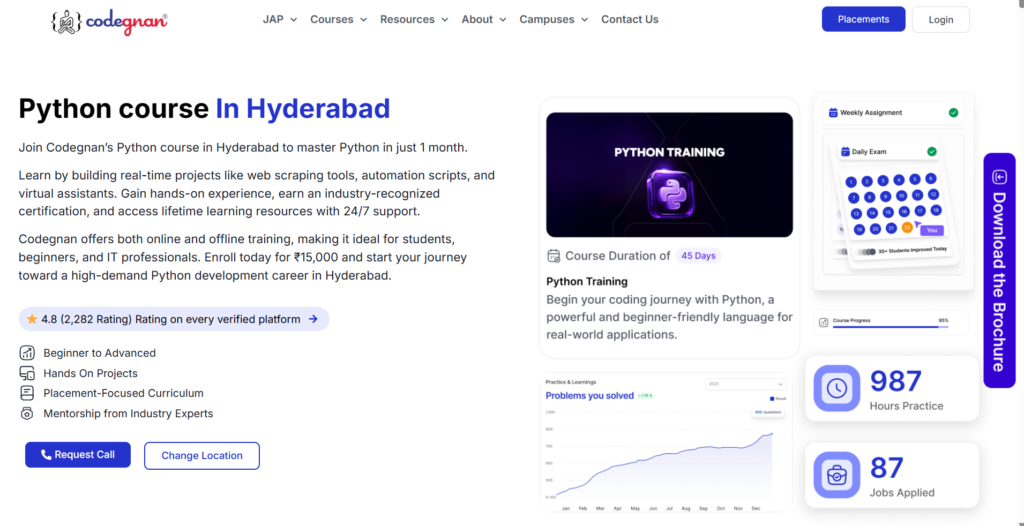
This course covers multiple projects.
In SQL, learn how to create tables, insert data, filter rows (WHERE, AND, OR), sort (ORDER BY), and perform aggregations (GROUP BY, COUNT, SUM). Then practice joins, subqueries, and window functions.
Data scientists must know SQL and NoSQL. While knowledge of SQL helps you know how to store and retrieve structured data efficiently, unstructured data requires NoSQL skills.
Step 3: Master core data science skills like EDA and data visualization

Goal: Understand and explain what your data is telling you.
What it is: Exploratory Data Analysis (EDA), feature inspection, and visual storytelling using tools like Pandas, Matplotlib, and Seaborn.
Why it matters: Before applying any machine learning model, you need to understand the data, and that’s where exploratory data analysis (EDA) comes in. EDA helps you identify missing values, outliers, correlations, and overall structure. It reveals hidden patterns and relationships that guide your modeling choices and feature engineering.
Data visualization, using tools like Seaborn, Matplotlib, or Power BI, lets you communicate complex findings in a clear and compelling way. These skills are crucial not just for analysis but for storytelling, turning raw numbers into insights that stakeholders can act on. Skipping EDA is like trying to solve a puzzle without looking at the pieces.
What to learn:
You need to learn how to load datasets using pandas, check for missing values, get summary statistics, and explore column-wise distributions. Understand how to find outliers using IQR and visualize trends and relationships with matplotlib and seaborn.
Then, focus on plots like histograms, boxplots, bar charts, scatter plots, and correlation heatmaps. Learn to identify multicollinearity, class imbalance, and patterns from graphs.
Download 5 datasets from Kaggle (start with Netflix titles, IPL matches, etc.) to practice.

For better understanding, you can practice these on the dataset:
- Use Pandas to check for null values, shape, dtypes, and unique counts.
- Create correlation heatmaps, distribution plots, and boxplots using Seaborn.
Then, you can write a mini-report for each dataset (EDA summary, key insights, graphs) in Jupyter Notebook.
Mini projects to try:
- Create an IPL player performance dashboard.
- Analyze Netflix genres over time using bar plots and word clouds.
- Explore air pollution datasets and visualize seasonal variation in major Indian cities.
Step 4: Understand and apply machine learning algorithms

Goal: Build models that can predict outcomes using real data.
What it is: Supervised learning (e.g., regression, classification), unsupervised learning (e.g., clustering), and ensemble methods like Random Forest.
Why it matters: Machine learning is at the heart of data science. Whether you’re predicting sales, classifying customer behavior, or detecting fraud, it all comes down to choosing the right model and tuning it well.
A strong grasp of supervised algorithms (like linear regression and decision trees) and unsupervised ones (like K-means clustering) lets you analyze patterns and make predictions that drive business impact. Without this skill, you can’t move from descriptive to predictive analytics, a key requirement in every mid-to-senior data science role.
What to learn:
You can start with supervised learning: linear regression, logistic regression, decision trees, and k-nearest neighbors. Learn how to prepare data (train-test split, feature scaling), train models, and evaluate them using metrics like accuracy, precision, recall, and RMSE.
Then move to unsupervised learning: clustering (KMeans), dimensionality reduction (PCA). Also, understand ensemble methods like Random Forest and Gradient Boosting. Learn how to tune hyperparameters with grid search.
We can also share a GitHub repository for machine learning.

If you join Codegnan’s Hyderabad machine learning course, you will work on different real-world projects. We offer hands-on projects like predicting housing prices, real-time rain prediction, stock price prediction, GDP prediction, and a Netflix recommendation system.
Step 5: Explore deep learning (optional for beginners)

Goal:
Understand how AI models like ChatGPT, face recognition, or image classifiers work.
What it is:
Deep learning includes things like neural networks, CNNs (for images), RNNs (for sequences), and transformers (used in ChatGPT).
Why it matters:
Deep learning is what powers advanced AI systems from voice assistants to self-driving cars and ChatGPT. Understanding how neural networks learn through backpropagation, activation functions, and gradient descent gives you an edge when working with unstructured data like images, text, and audio.
Even if you don’t specialize in AI, knowing the fundamentals of CNNs, RNNs, and transformers helps you evaluate when traditional ML is enough and when it’s time to bring in deep learning for better accuracy or automation.
What to learn:
You can begin with the structure of neural networks: input layer, hidden layers, output, activation functions (ReLU, sigmoid), and backpropagation. Learn about CNNs for image data, RNNs for time series and text, and get familiar with transformers used in large language models like ChatGPT.
Understand loss functions, gradient descent, epochs, and how models are trained using libraries like TensorFlow or PyTorch.
How to practice:
- Train a basic image classifier using the MNIST dataset.
- Use TensorFlow Playground (no-code) to understand how changing parameters affects learning.
- Build a simple RNN to predict the next character in a string sequence.
Mini projects to try:
- Handwritten digit recognition using CNNs.
- Sentiment analysis on Twitter data.
- Image classifier for identifying different food items.
Step 6: Learn model deployment and basic MLOps

Goal:
Learn how to turn your ML project into something others can see and use.
What it is:
It’s not enough to build a model; you need to make it available via a web app. Tools like Streamlit, Flask, or FastAPI help you do this.
Why it matters:
In the real world, a model stuck inside a Jupyter Notebook is useless unless people can interact with it. That’s where deployment comes in. When you use tools like Flask, Streamlit, or FastAPI to create web apps, you turn your models into working products.
Understanding deployment pipelines, version control, and APIs is also the gateway to MLOps, a fast-growing area that combines data science with DevOps to automate the entire model lifecycle. Employers look for this skill because it shows you can work end-to-end: from data to insight to product.
What to learn:
Learn how to turn your Jupyter-based models into deployable apps using Streamlit, Flask, or FastAPI. Understand how to expose your model via an API, create front-end input forms, and display predictions. Learn about version control (Git), virtual environments, and requirements.txt files.
You can get a basic understanding of CI/CD, Docker, and how to host apps on platforms like Render, Railway, or Hugging Face Spaces.
How to practice:
- Convert your ML model (e.g., house price predictor) into a Streamlit app.
- Add interactive widgets like sliders and dropdowns for user input.
- Push your code to GitHub and deploy it for public access.
Mini projects to try:
- Build and deploy a movie recommendation app.
- Deploy a diabetes prediction model using FastAPI.
- Create a Streamlit-based resume screen that scores applicants based on keyword matching.
Step 7: Build and showcase real-world projects in a portfolio

Goal: Show proof of your skills to recruiters
What it is: A portfolio with real code, working demos, and proper documentation
Why it matters: Your portfolio is proof that you can apply what you’ve learned to solve real problems. Recruiters want to see that you can handle messy data, create useful models, and explain your work clearly. A strong portfolio with GitHub repos, interactive dashboards, and a personal site builds credibility and trust, especially if you’re switching careers or don’t have a formal CS degree.
Each project acts as a mini case study that shows your thought process, problem-solving approach, and tech stack proficiency (e.g., pandas, matplotlib, Scikit-learn, Streamlit).
What to do:
You can create a profile on GitHub as a portfolio of your past works, and the login page looks like this

We searched for multiple data science repositories, and here is one for you. You can follow this to create data science projects of your own.

You can follow this data scientist’s account to see what a professional portfolio looks like.

There are numerous other data science repositories on GitHub that you can follow. These profiles can help you create one for yourself and share its link on your resume. It allows recruiters to get a better understanding of your practical knowledge, skills, and expertise, and see your past work.

If you aren’t sure how to do projects, you can visit this GitHub public repository, which provides multiple projects with source code.

Another good way to start doing projects is to join Codegnan. We offer a range of projects that are beginner-friendly, and you get complete assistance from industry experts. This will help you clear doubts while gaining practical skills and solving real-world challenges.

Step 8: Apply for internships and entry-level data science jobs

Goal:
Land your first opportunity in data science
What it is:
Internships, freelance gigs, and entry-level roles in analytics
Why it matters:
Learning alone won’t land you a job; practical experience does. Internships, entry-level roles, and freelance gigs expose you to real-world data challenges, business stakeholders, deadlines, and team collaboration.
You’ll also get feedback on your work, improve communication skills, and learn how to prioritize tasks. Every role you take adds to your resume, expands your network, and gets you one step closer to a full-time data scientist position. It’s also the best way to apply your theoretical knowledge in a production-grade environment.
What to do:
You can start looking for various internships or entry-level job opportunities on different job boards like LinkedIn, Indeed, Naukri, etc.
I found nearly 23,015+ data science job roles on LinkedIn, among which almost 3,279+ are entry-level data science jobs.

Let me share with you the basic requirements of a data scientist from a job post on LinkedIn.

If you are joining Codegnan, you don’t need to worry about finding a job. We offer internship and job opportunities to all our data science learners with a promise of almost 150+ drives every year.

👉 Data science-related resources:
- Data Scientist Salary in Hyderabad
- 📈 Future scope of data science career in India
- The beginner’s guide to data science
Step 9: Earn certifications to increase credibility

Goal:
Stand out when applying for jobs
What it is:
Certificates from trusted platforms like Coursera, Codegnan, DataCamp
Why it matters:
Certifications act as formal recognition of your skills and can make your resume stand out, especially when you don’t have a degree in computer science or engineering. Reputable certificates from platforms like Coursera, DataCamp, or Codegnan show that you’ve followed a structured curriculum, completed real projects, and been evaluated by experts.
Some platforms even include capstone projects, peer reviews, or job assistance, making your learning more practical and industry-relevant. In a competitive job market, certifications give you an edge during screening and interviews.
What to do:
You can join Data Science certification courses in India to learn and gain practical skills. Codegnan offers industry-recognised certification for data science. You learn everything you need to know to become a data scientist and earn an attractive package.

Here’s our learner reviewing the data science course

Besides acquiring data science certifications, you need to upskill yourself by joining different events. You can follow the 10times website and check out data science events arranged in different parts of India.

What topics and subjects to learn to become an expert data science engineer?
If you want to become a skilled data science engineer, you need to master a combination of theory, tools, and practical skills. Each subject below builds your ability to extract insights, solve business problems, and build data-powered solutions.
1. Statistics and Probability: Build the foundation for data thinking
Understanding statistics and probability is essential for interpreting data and making informed decisions. You’ll learn concepts like mean, median, standard deviation, probability distributions, sampling, and hypothesis testing.
These are critical for analyzing trends, validating models, and avoiding false conclusions. A strong statistical foundation allows you to confidently explain why your models work and how reliable your insights are.
2. Python Programming: Automate, analyze, and build models
Python is the most widely used programming language in data science due to its simplicity and flexibility. You can start by learning core concepts like data types, loops, functions, and error handling.
Then explore libraries like NumPy for computation, Pandas for data manipulation, and Scikit-learn for machine learning. Knowledge of Python helps you automate tasks, clean data, build models, and create end-to-end data workflows.
3. Data Cleaning and Preprocessing: Prepare messy data for analysis
In real-world projects, data is rarely perfect. You’ll often encounter missing values, duplicates, inconsistent formats, and outliers. Learn techniques to clean and transform data using tools like Pandas and Scikit-learn.
This includes filling or removing missing values, encoding categorical data, scaling features, and handling outliers. Clean data ensures that your models perform well and that your insights are accurate and trustworthy.
4. Machine Learning Algorithms: Solve problems through prediction and classification
Machine learning allows you to build systems that learn from data and make predictions. You can start with algorithms like linear regression, decision trees, logistic regression, and clustering methods.
We recommend you learn how to evaluate models using metrics such as accuracy, recall, and F1-score. These techniques are used to solve real-world problems like fraud detection, customer churn, price forecasting, and recommendation systems.
5. Data Visualization: Communicate insights clearly and persuasively
Data visualization helps you transform complex data into easy-to-understand visuals. You must know how to create charts and dashboards using tools like Matplotlib, Seaborn, or Tableau. Then, focus on choosing the right type of chart, labeling axes clearly, and highlighting trends.
Visualization is not just about aesthetics; it’s a communication skill that allows you to present findings to stakeholders and support decisions with data.
6. SQL and Databases: Extract data from real-world sources
Structured Query Language (SQL) is essential for accessing and analyzing data stored in relational databases. Learn how to write SQL queries to filter, join, sort, and group data. Understanding database structures and schemas will help you retrieve only the data you need.
SQL is a must-have skill for any data professional, as most organizations store their business data in databases.
7. Deep Learning (Advanced): Learn the basics of modern AI
Deep learning is a subfield of machine learning focused on neural networks and large-scale data. Learn how artificial neural networks work and study specialized models like CNNs for image tasks and RNNs for sequences.
You can use frameworks like TensorFlow or PyTorch to build and train models. Deep learning is essential if you plan to work in advanced AI domains such as computer vision or natural language processing.
8. Big Data and Cloud Tools: Handle data at scale
Large organizations deal with terabytes of data that can’t be processed using traditional tools. Learn about big data technologies like Apache Spark and Hadoop for distributed data processing.
Get hands-on with cloud platforms such as AWS, Google Cloud, or Azure. These tools allow you to store, process, and analyze data at scale, which is critical for enterprise-level data science projects.
9. Real-World Projects: Apply what you learn through hands-on work
Building real-world projects is the best way to apply your skills and showcase your expertise. Work with datasets from platforms like Kaggle, UCI, or Data.gov.
Try building a movie recommender system, a sales forecast model, or a customer segmentation dashboard. These projects prove that you can solve practical business problems and prepare you for technical interviews and job roles in data science.
10. Domain Knowledge: Understand the business context behind the data
Data science becomes powerful when applied to real business problems. Choose a specific domain like finance, healthcare, retail, or marketing, and learn how data is used in that industry. Study key metrics, common use cases, and past case studies. Domain knowledge helps you build models that are not only technically sound but also aligned with real-world goals and decision-making.
What is the average data science salary in India?
The average data science salary in India is around ₹15.4 lakhs annually, with experts earning ₹4 lakhs – ₹29.2 lakhs annually. Their average monthly in-hand salary is ₹75,000 – ₹77,000. This salary changes based on your experience, skills, and expertise. You can start with an annual salary of ₹4 lakhs and then enrol for advanced courses or get industry-recognized certification to increase your salary.

At Codegnan, we have detailed guides and resources to help you become a job-ready data scientist. Explore them now:
- Data Science Projects For Beginners With Source Code
- Data Science Interview Questions
- Data science career paths that are in demand
What does a data scientist do?
A data scientist collects, cleans, and analyzes large volumes of data to uncover patterns, solve problems, and support decision-making. They use statistical methods, machine learning, and programming to build predictive models and automate insights. Their work helps businesses improve operations, understand customer behavior, and forecast future trends.
Data scientists also create visualizations and reports to communicate findings clearly to both technical and non-technical teams.
How does Codegnan help college students go from a beginner to a job-ready data scientist?
Codegnan helps college students become job-ready data scientists by combining hands-on learning with real-world projects, 1:1 mentorship, and career guidance.
Their approach goes beyond just teaching tools; students build portfolios, deploy ML apps, solve business problems, and practice interview-ready skills.
With structured modules, live sessions, and job assistance, beginners gain both technical depth and industry exposure.
👉 Contact our experts and get a guide to become a data science expert in India.