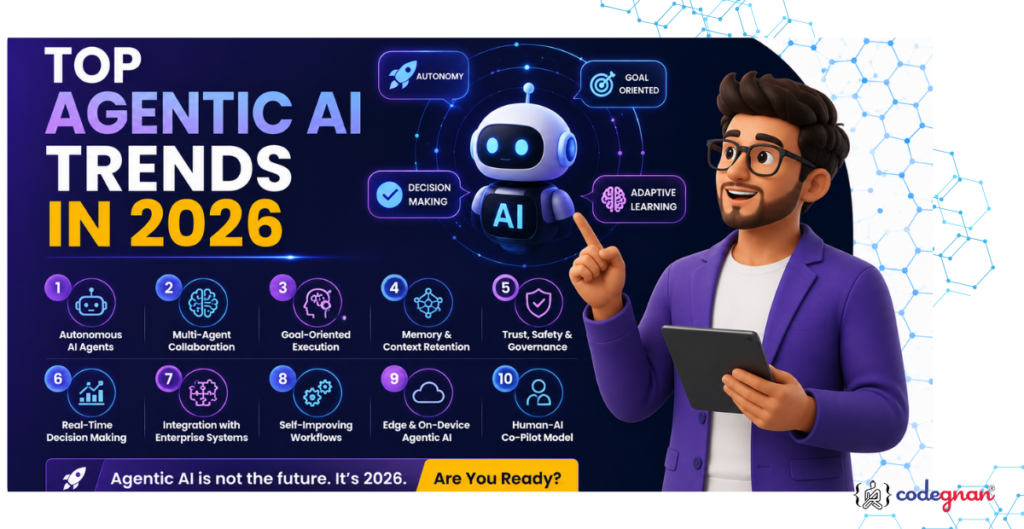





Artificial intelligence is no longer just answering questions. In 2026, it will make decisions, execute tasks, and run entire workflows without waiting for human instructions at every step. This is the world of Agentic AI, and it is reshaping how businesses operate, how developers build software, and how professionals navigate their careers. From boardrooms in Hyderabad to startup offices in Vijaywada, Agentic AI is no longer a buzzword. It is a strategic priority. If you are exploring AI careers, understanding the top agentic AI trends in 2026 is essential.
This blog covers everything from what is driving the agentic AI boom to the skills you need, with a special focus on what this means for India.
What Is Driving Agentic AI Growth in 2026
Several forces are converging to make 2026 the breakout year for Agentic AI.
Better Foundation Models: Large language models (LLMs) have grown dramatically more capable. Models now reason in multi-step chains, understand context across long sessions, and plan sequences of actions all prerequisites for truly agentic behaviour.
Enterprise Pressure for Efficiency: Businesses are facing a simultaneous demand for speed, scale, and cost reduction. Traditional automation (RPA, rule-based bots) has hit its ceiling. Agentic AI offers the next level adaptive, goal-driven automation that handles exceptions, not just scripts.
Cloud Infrastructure at Scale: Providers like AWS, Google Cloud, and Microsoft Azure have made it dramatically cheaper and faster to deploy AI workloads. This has removed a major barrier for startups and mid-sized companies to experiment with agent-based systems.
Regulatory and Competitive Pressure: As competitors adopt agentic tools to accelerate operations, businesses that don’t adapt risk falling behind. At the same time, AI regulations in the EU and emerging frameworks in India are pushing organisations toward more transparent, governed AI which is accelerating structured agentic adoption.
According to research cited by EY India, Agentic AI takes goal-driven decisions and acts independently in complex and changing environments unlike rule-based systems or predictive AI. This fundamental shift in AI architecture is what powers 2026’s growth.
The numbers are striking. As per Gartner, Agentic AI will be featured in 33% of enterprise software by 2028, leading to 80% of customer service problems being solved independently, saving 30% of the total costs by 2029.
Autonomous AI Agents Becoming Mainstream
Just two years ago, autonomous AI agents were largely research demos and developer experiments. In 2026, they are production-grade tools running inside real enterprises.
Businesses are moving away from AI assistants that respond to prompts and toward autonomous agentic systems that operate based on goals. Earlier AI tools focused on helping users complete tasks such as drafting content or summarising data. While helpful, these systems required continuous human involvement. In contrast, agentic AI systems interpret objectives, plan steps, and act independently within approved boundaries.
What makes this mainstream moment possible? Three technical advances:
Reasoning Chains: AI agents can now plan multi-step processes think of a customer support agent that first checks an order status, then decides whether to escalate, then drafts a resolution email and sends it all without human intervention.
Tool Use: Modern agents connect to external APIs, databases, calendars, CRMs, and file systems. They don’t just generate text; they act on the world.
Memory and Context: Agents can maintain context across long interactions, revisiting earlier facts to make better decisions later in a workflow.
For professionals exploring AI: understanding how to build, deploy, and manage autonomous agents is quickly becoming one of the most valuable skill sets in the tech industry. If you are looking to learn Python for AI and machine learning, 2026 is the right time to get started.
Multi-Agent AI Systems Are Rising
Single agents are powerful. But the real leap in 2026 is multi-agent systems networks of specialised AI agents that collaborate to handle complex, interconnected workflows.
Single-agent systems perform well for isolated tasks, but modern operations are interconnected. This has led to a strong market trend toward AI orchestration, where multiple agents collaborate, validate outcomes, and coordinate actions across processes. Multi-agent systems divide responsibilities among specialised agents one agent may analyse data, another may validate results, while a third executes actions.
Think of it like a well-functioning team: each member has a role, they communicate in real time, and they adjust when something goes wrong. In an enterprise context, multi-agent systems might include:
- A data agent pulling and cleaning information from multiple sources
- A decision agent evaluating options against business rules
- An execution agent triggering downstream actions like sending emails or updating CRM records
- A monitoring agent watching for errors and escalating when needed
In FMCG companies, multi-agent systems help manage stock autonomously, detect sales fraud, and ensure safety compliance. Multiple AI agents collaborate and make necessary adjustments without human input.
The Google Cloud AI Agent Trends 2026 report, backed by insights from over 3,400 global executives, describes this as a move from tasks to systems not just one-off prompts, but “digital assembly lines” that run entire workflows.
For developers, this is where frameworks like LangChain, CrewAI, and the OpenAI Agents SDK come in. These tools provide the scaffolding to build multi-agent architectures without starting from scratch.
Enterprise AI Agents Are Replacing Manual Workflows
Across industries, enterprise AI agents are taking over repeatable, high-volume, logic-driven workflows that previously consumed enormous amounts of human time.
Instead of relying on rigid automation rules, multi-agent systems adapt to real-world changes. When conditions shift, agents adjust roles and priorities without breaking workflows. A simple example is an internal process where agents manage scheduling, approvals, and resource allocation together, ensuring tasks move forward even when conditions change.
Some of the highest-impact enterprise use cases in 2026:
Finance and Accounts: AI agents are handling invoice processing, expense categorisation, fraud detection, and financial reporting tasks that previously required teams of analysts.
Human Resources: From resume screening to onboarding checklist management, AI agents are handling structured HR workflows end to end.
IT Operations (AIOps): Agents monitor infrastructure, detect anomalies, auto-remediate known issues, and page humans only for novel problems. This dramatically reduces MTTR (mean time to resolution).
Customer Service: AI is expected to carry out 80% of customer service interactions globally, with strong expected growth from Indian companies.
Supply Chain and Logistics: Agentic systems monitor inventory levels, predict shortages, trigger reorders, and even reroute shipments in real time.
The business case is compelling. Agentic AI reduces reliance on human input, freeing teams to focus on critical work and respond better to market shifts while human oversight remains crucial to find the right balance between automation and decision-making.
For those interested in enterprise AI implementation, Codegnan’s Data Science and AI training programmes cover the fundamentals needed to work in these environments.
AI Copilots Becoming Workplace Standard
While fully autonomous agents handle backend workflows, AI copilots are becoming the default interface for knowledge workers in 2026.
An AI copilot works alongside a human, providing real-time suggestions, drafting content, summarising information, flagging risks, and retrieving relevant data while keeping the human in control of final decisions. GitHub Copilot for developers, Microsoft 365 Copilot for office work, and Salesforce Einstein Copilot for CRM are among the most widely adopted.
In 2026, the trend has expanded far beyond these flagship products. Industry-specific copilots are appearing in healthcare (clinical documentation), legal (contract review), education (personalised tutoring), and financial services (investment research).
Key characteristics of the 2026 copilot standard:
- Always-on context awareness: Copilots now understand not just the current document but the broader project context, past communications, and organisational policies.
- Action capability: Beyond suggestions, copilots can now execute approved actions send an email, create a ticket, update a spreadsheet.
- Personalisation: Copilots learn individual working styles over time, becoming more useful the longer they are used.
For students and early-career professionals, learning to work with AI copilots effectively is becoming as fundamental as learning to use a spreadsheet was in the 1990s. Codegnan’s full stack development courses help learners build the technical foundation to create and integrate copilot-grade applications.
AI Agents + Robotics Integration
One of the most exciting frontiers of 2026 is the convergence of AI agents with physical robotics often called embodied AI or physical AI.
Until recently, robots were largely limited to pre-programmed, repetitive tasks in tightly controlled environments (like car assembly lines). AI agents are now giving robots the ability to interpret natural language instructions, adapt to unstructured environments, and make contextual decisions on the fly.
Key developments in this space:
Warehouse and Logistics Robots: Companies like Amazon and Flipkart are deploying AI-driven robots that can navigate dynamic warehouse floors, pick varied products, and work alongside humans safely.
Surgical and Medical Robotics: AI agents are being integrated into surgical robots to provide real-time guidance during procedures, analyse imaging data on the spot, and flag anomalies.
Agricultural Robots: In India’s large agricultural sector, agentic robotic systems are being piloted for precision spraying, crop monitoring, and autonomous harvesting.
Humanoid Robots: Platforms like Boston Dynamics’ Atlas and Tesla’s Optimus, guided by large AI models, are beginning to perform generalised physical tasks in industrial settings.
Agentic AI in manufacturing is moving from predictive maintenance to sustainable operations by acting on data without human input. It detects faults, decides the next steps, and initiates repairs or production shifts adapting workflows in real time and managing inventory through smarter resource use.
The intersection of software agents and physical systems is set to create entirely new categories of jobs and entirely new categories of risk over the next decade.
Vertical AI Agents for Specific Industries
One of the clearest patterns of 2026 is the shift from general-purpose AI to vertical AI agents agents purpose-built for a specific industry’s workflows, terminology, regulations, and data.
Generic systems often struggle with industry-specific rules, terminology, and workflows. In response, organisations are adopting agents tailored to their operational context. Domain-specific agents understand not just tasks, but the environment in which decisions occur delivering faster value because they require less adjustment and produce more relevant outcomes.
Some of the most prominent vertical AI agents in 2026:
Healthcare Agents: In healthcare, Agentic AI is shifting from pattern recognition to active involvement in diagnosis, treatment planning, and patient monitoring. It can monitor real-time vitals, trigger alerts, suggest interventions, and assist in referrals and can even file insurance claims or prompt patient engagement without constant human oversight.
Legal AI Agents: Trained on case law, contract databases, and regulatory frameworks, legal agents can perform due diligence, flag clause risks in contracts, and draft standard legal documents.
Financial Services Agents: In financial services, Agentic AI is being explored for real-time tasks like fraud mitigation, credit risk evaluation, and customer service routing noticing issues, temporarily stopping suspicious payments, and adjusting investment portfolios based on market changes.
EdTech Agents: In India’s booming education technology sector, vertical agents are personalising learning paths, identifying struggling students early, and automating administrative tasks for educators.
The vertical specialisation trend means companies no longer need to build AI from scratch. Instead, they can deploy pre-trained vertical agents and customise them for their specific context dramatically shortening time-to-value.
AI Agent Memory and Long-Term Context
One of the most transformative technical advances powering 2026’s agentic AI is persistent memory the ability of AI agents to remember information across sessions, personalise responses over time, and maintain awareness of long-running workflows.
Earlier AI systems (including early chatbots and basic LLMs) were entirely stateless. Every conversation started from zero. Agentic AI is changing this fundamentally.
How AI Memory Works in 2026:
- Short-term memory holds context within a single session the current conversation, document, or task.
- Long-term memory stores information across sessions user preferences, past decisions, project history typically in a vector database.
- Episodic memory lets agents recall specific past events and outcomes to inform current decisions.
Real-world applications of AI agent memory:
Personalised AI Assistants: An AI assistant that knows you prefer bullet-point summaries, always check emails at 9am, and are currently focused on a product launch and adjusts its behaviour accordingly.
Long-running Workflow Management: Complex projects (like software development sprints or legal case management) require continuity across weeks. AI agents with persistent memory can track what has been done, what is pending, and what decisions were made and why.
Adaptive Customer Experiences: AI agents serving customers remember past interactions, purchase histories, and stated preferences delivering genuinely personalised service rather than treating every interaction as a first contact.
Context-Aware Automation: Rather than triggering actions based on simple rules, memory-enabled agents trigger actions based on meaningful context understanding not just what happened but why it matters.
This development is bringing AI considerably closer to the kind of intelligent, relationship-based assistance that was previously only possible with human professionals. If you are interested in building AI applications with memory and context, understanding machine learning fundamentals is an excellent starting point.
Agentic AI Security and Governance Trends
As AI agents gain autonomy and access to sensitive systems, security and governance have moved from afterthought to top priority for enterprise AI deployments in 2026.
Governance-first design is becoming central to Agentic AI adoption. Businesses are no longer deploying agentic systems without safeguards. Instead, governance is being built directly into system design rather than added later including permission boundaries, decision logs, and approval checkpoints. These elements ensure agents act only within approved scopes and provide clear records of actions taken.
The stakes are high. According to Gartner, 25% of enterprise cybersecurity incidents will be due to the misuse of AI agents by both external attackers and internally suspicious individuals by 2028.
Key governance trends shaping 2026:
AI Compliance and Regulatory Alignment: The EU AI Act is now in force, and India’s draft AI governance framework is progressing. Enterprises must document how their AI agents make decisions, demonstrate fairness, and maintain audit trails. Non-compliance carries real legal and reputational risk.
Audit Trails and Explainability: Boards and regulators are demanding that AI decisions be explainable. Enterprises are investing in tools that log agent actions, flag unusual behaviour, and provide human-readable explanations of why an agent did what it did.
Data Privacy in Agentic Systems: Agents with access to customer data, internal financials, and strategic plans present serious data governance challenges. Zero-trust architectures, data minimisation principles, and role-based agent permissions are becoming standard.
Human Oversight by Design: An agent handling operational decisions may act independently but pause when actions exceed predefined risk thresholds this reflects a broader understanding that autonomy without control creates risk, while controlled autonomy creates value.
AI Safety Regulations: Globally, governments are moving toward requiring safety evaluations for high-risk AI deployments, particularly in healthcare, financial services, and critical infrastructure.
For enterprises in India, alignment with both global frameworks (EU AI Act, NIST AI RMF) and domestic regulations is fast becoming a board-level concern.
Open-Source AI Agent Ecosystem Expanding
One of the most democratising forces in 2026’s agentic AI landscape is the explosion of open-source tooling. Developers no longer need to build multi-agent systems from scratch or rely entirely on proprietary platforms a rich ecosystem of open frameworks makes sophisticated agentic AI accessible to anyone.
LangChain has emerged as one of the most widely adopted frameworks for building LLM-powered applications and agent pipelines. It provides modular components for connecting language models to tools, memory stores, and data sources enabling rapid development of complex agentic workflows. LangChain’s extensive library of integrations and active developer community have made it a go-to for production agent development.
AutoGPT was an early pioneer of the autonomous agent concept, demonstrating that LLMs could recursively plan and execute tasks toward a long-term goal. While it has evolved significantly since its viral debut, AutoGPT’s architecture continues to influence how developers think about agent autonomy and self-directed task completion.
CrewAI has gained significant traction in 2026 as a framework specifically designed for multi-agent collaboration. CrewAI allows developers to define agent roles, assign goals, and orchestrate crews of specialised agents working together mirroring how human teams operate. Its role-based architecture makes it particularly well-suited for complex business workflows.
OpenAI Agents SDK provides a production-ready foundation for building agents using OpenAI’s models, with built-in support for tool calling, handoffs between agents, and guardrails for safe autonomous operation. Its tight integration with GPT-4 class models and growing plugin ecosystem make it a strong choice for enterprise deployments.
Beyond these flagship tools, the open-source ecosystem includes frameworks for agent memory (MemGPT), agent evaluation (AgentBench), agent security (Rebuff for prompt injection defence), and agent observability (LangSmith, Weights & Biases).
For developers looking to enter the agentic AI space, mastering at least one of these frameworks alongside a strong Python foundation is the fastest path to employability. Codegnan’s Python training programme provides the fundamentals needed to work effectively with these tools.
AI Agents and Generative AI Convergence
In 2026, the line between Generative AI and Agentic AI is dissolving. The two technologies are converging into a single paradigm: agents that generate content, decisions, code, and actions all guided by the same underlying foundation models.
Earlier, generative AI and autonomous agents were somewhat separate concepts. Generative AI (text, image, audio, code generation) was about output quality. Agentic AI was about autonomous task completion. In 2026, they are deeply intertwined:
Generative AI as Agent Brain: LLMs serve as the reasoning engine for AI agents planning sequences of actions, generating tool calls, drafting communications, and interpreting results. Models like GPT-4o, Gemini 1.5 Pro, Claude 3.5, and Llama 3 are all being used as agent “brains.”
Agents Generating Multimodal Content: Agents in 2026 don’t just send text messages they generate reports with charts, create presentation slides, produce code, synthesise audio summaries, and even generate images for marketing content all in service of completing a broader goal.
RAG-Powered Agents: Retrieval-Augmented Generation (RAG) gives agents access to current, specific knowledge beyond their training data. An enterprise AI agent might combine RAG with its company’s internal knowledge base to answer questions that no general model could handle.
Code-Generating Agents: Platforms like GitHub Copilot, Cursor, and Devin are blurring the line between AI assistants and autonomous software development agents. In 2026, AI agents can write code, run tests, debug errors, and deploy updates with humans reviewing and approving key checkpoints.
This convergence is accelerating the value of AI across the board. If you are studying full stack development or data science, understanding how generative AI and agentic systems interact is increasingly important.
Low-Code and No-Code AI Agent Platforms
One of the most significant democratisation trends of 2026 is the rise of low-code and no-code platforms that allow non-technical users to build, configure, and deploy AI agents without writing a single line of code.
This is a fundamental shift in who can participate in the AI economy.
Key platforms driving this trend:
- Microsoft Copilot Studio allows business users to build custom AI copilots using a drag-and-drop interface, connecting to Microsoft 365 data and external APIs.
- Zapier AI Agents extends the popular automation platform with agentic capabilities, letting users build multi-step, AI-driven workflows visually.
- Make (formerly Integromat) has added AI agent capabilities to its visual automation builder, enabling complex conditional workflows without code.
- Botpress and Voiceflow allow businesses to build sophisticated conversational AI agents using visual editors.
- Google Vertex AI Agent Builder provides enterprise-grade no-code tools for building agents grounded in company data.
Impact on businesses:
For startups, these platforms eliminate the need to hire specialised AI engineers to build first-generation AI tools. A founder can build an AI-powered customer support agent or lead qualification system in days, not months.
For SMEs (Small and Medium Enterprises), no-code AI agents are levelling the playing field against larger competitors. A mid-sized logistics company can deploy an AI agent to handle customer queries and track shipments without an in-house AI team.
For large enterprises, low-code platforms allow business domain experts (who understand the workflows deeply) to build agents without full dependency on IT backlogs.
The democratisation of AI development is creating enormous opportunities and also raising important governance questions about quality, safety, and data handling when non-technical users deploy AI systems. Understanding the foundations of how these systems work (even as a non-developer) is increasingly valuable. Codegnan’s AI and data science programmes are designed to give learners exactly this grounding.
Agentic AI Trends in India
India is not just adopting Agentic AI it is rapidly becoming one of the world’s most important markets for its development and deployment.
Indian Startups Leading the Charge
A new generation of Indian AI startups is building native agentic AI products, not just reselling international tools. Companies in Bengaluru, Hyderabad, Mumbai, and Pune are building vertical AI agents for healthcare, legal tech, edtech, fintech, and agriculture. India’s large, digitally engaged population and diverse, data-rich industries create natural testbeds for agentic systems.
IT Services Giants Investing Heavily
India’s IT services sector a global powerhouse is undergoing a fundamental transformation driven by Agentic AI.
Infosys has launched its AI-First strategy, embedding agentic AI into service delivery models. The company’s Topaz AI platform incorporates agentic capabilities to accelerate software development, business process automation, and enterprise analytics.
TCS (Tata Consultancy Services) is investing deeply in AI agents for enterprise clients, with its AI.Cloud platform and partnerships with hyperscalers enabling deployment of agentic systems at scale for its global client base. TCS is also retraining hundreds of thousands of employees on AI-augmented working practices.
Zoho, India’s homegrown SaaS giant, has been integrating AI agents across its suite of business applications from Zia (its AI assistant) to increasingly autonomous agents embedded in Zoho CRM, Zoho Desk, and Zoho Analytics. Zoho’s focus on the SME market makes it a key player in democratising agentic AI for Indian businesses.
AI-Driven SaaS Growth
India’s SaaS sector is experiencing a second wave of growth powered by AI. Investors are backing AI-native SaaS companies that build agentic capabilities from day one rather than bolting AI onto legacy software. Sectors seeing the fastest AI-driven SaaS growth include HR tech, fintech, health tech, agri-tech, and legal tech.
Government and Public Sector Adoption
India’s government is also moving toward AI-enabled operations. Initiatives like Digital India and the National AI Strategy are creating demand for AI agents in public services from citizen grievance systems to agricultural advisory platforms.
For students and professionals in India, this national-scale adoption creates massive career opportunity. Cities like Hyderabad, which is emerging as a major AI hub, are particularly well-positioned. If you are in Hyderabad and looking to build AI skills, Codegnan’s AI courses in Hyderabad are designed with the current market in mind.
Skills in Demand for Agentic AI Careers
The rise of Agentic AI is creating a wave of new job roles and reshaping the skills required for existing ones. Here is what the 2026 job market is looking for:
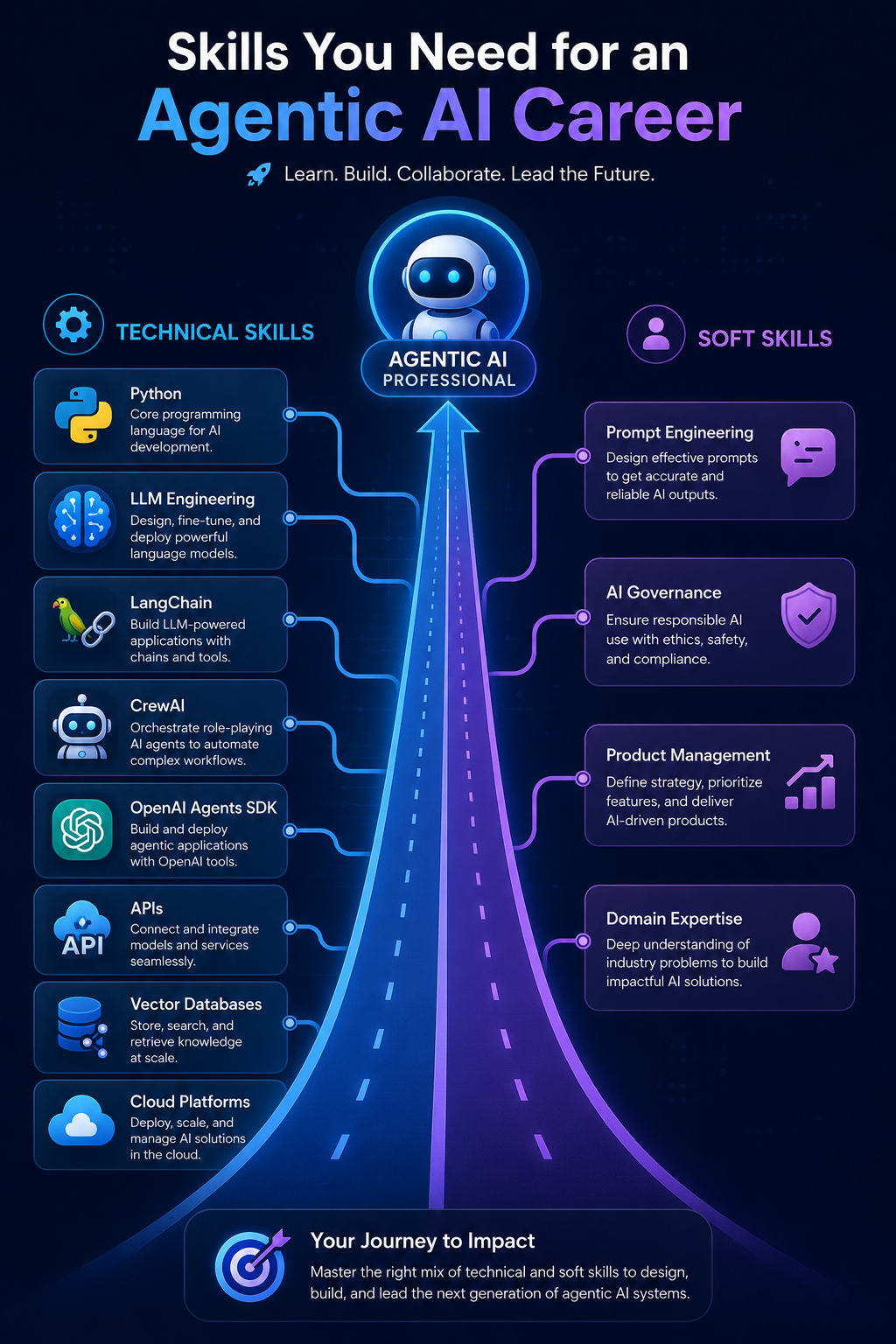
Technical Skills
Python Programming is the foundation of virtually all AI and agent development. Proficiency in Python, including libraries like NumPy, Pandas, and familiarity with async programming, is non-negotiable.
LLM Engineering: Understanding how to prompt, fine-tune, and deploy large language models including techniques like RAG (Retrieval-Augmented Generation), function calling, and context management.
Agentic Frameworks: Hands-on experience with LangChain, CrewAI, AutoGPT, or the OpenAI Agents SDK is increasingly expected in AI engineering roles.
API Integration: AI agents live or die by their tool access. Skills in REST API integration, authentication, and data transformation are essential.
Vector Databases: Platforms like Pinecone, Weaviate, and ChromaDB power AI memory. Understanding how to index, query, and manage vector stores is a specialist skill in growing demand.
Cloud Platforms: AWS Bedrock, Google Vertex AI, and Azure AI Studio are the enterprise deployment environments for AI agents. Familiarity with at least one major cloud provider is expected.
MLOps and Agent Observability: Deploying and monitoring AI agents in production including logging, performance tracking, error handling, and cost management is a rapidly growing sub-discipline.
Non-Technical Skills
AI Product Management: Defining what an AI agent should do, setting success metrics, and managing its lifecycle is a distinct skill set in growing demand.
AI Ethics and Governance: As compliance requirements grow, professionals who understand AI governance frameworks, bias detection, and responsible AI principles are highly valued.
Prompt Engineering: While models are improving, the ability to craft clear, effective instructions for AI systems and understand why they fail remains valuable.
Domain Expertise + AI Literacy: Subject matter experts (in finance, law, healthcare, logistics) who understand how to apply AI agents in their field are often more valuable than generalist AI engineers.
For those in Hyderabad and Telangana looking to build these skills, Codegnan offers specialised programmes in Python, Machine Learning, Data Science, Full Stack Development, and Artificial Intelligence all designed with current industry demand in mind.
Future Predictions for Agentic AI
Looking beyond 2026, the trajectory of Agentic AI points toward some remarkable shifts:
AI Agents Will Manage AI Agents: Meta-agents AI systems that orchestrate other AI agents are already emerging. By 2028, it will be common for a single “manager agent” to dynamically spawn, assign, and retire specialised sub-agents based on task requirements.
From Tools to Teammates: IBM and Salesforce expect one billion AI agents to be operational across the world by the end of 2026. By 2028-2030, agents will be treated less like tools and more like digital colleagues with defined roles, performance reviews, and escalation paths.
AI Board Advisors: 10% of global boards are predicted to seek guidance from AI for key executive decisions by 2029. Strategic AI advisors agents with access to financial data, market intelligence, and company history will support (not replace) executive decision-making.
Hyper-Personalised Agentic Experiences: As memory and context capabilities mature, AI agents will provide experiences that feel deeply personal adapted not just to user preferences but to real-time emotional context, cognitive load, and situational urgency.
Regulatory Maturation: Global AI regulations will consolidate around common principles transparency, human oversight, and accountability. Enterprises that build governance-first from 2026 onward will have a significant compliance advantage.
The Agentic Internet: Much like the mobile internet created a new layer of digital interaction, agentic AI may create a new layer of the web where agents browse, transact, negotiate, and create on behalf of humans at scale.
The transition from AI as a tool to AI as an actor is one of the most profound shifts in the history of computing. Whether you are a developer, a business leader, or a student, building fluency with Agentic AI now is the most future-proof investment you can make.
FAQs
What is Agentic AI?
Agentic AI refers to artificial intelligence systems that can set goals, plan sequences of actions, use tools, and execute tasks autonomously without requiring human instruction at every step. Unlike traditional AI that responds to individual prompts, agentic AI acts proactively toward defined objectives. It can browse the web, write and run code, manage files, send communications, and interact with other systems adapting its approach based on results and changing conditions.
What are the top Agentic AI trends in 2026?
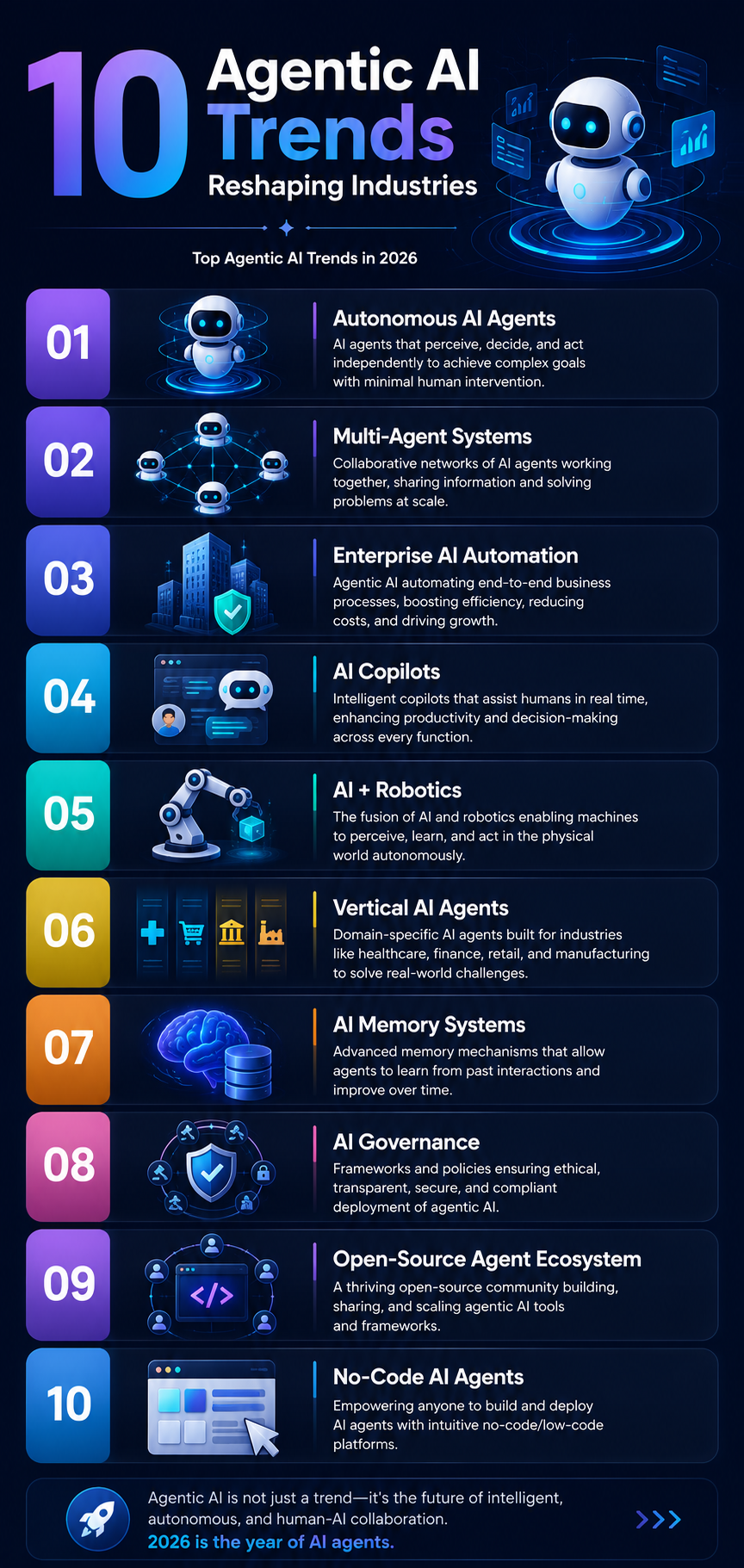
The top agentic AI trends in 2026 include: the mainstream adoption of autonomous AI agents, the rise of multi-agent collaboration systems, enterprise AI replacing manual workflows, AI copilots becoming standard workplace tools, the convergence of generative AI and agentic AI, vertical AI agents for industry-specific applications, low-code/no-code agent platforms democratising AI development, persistent memory and long-term context in agents, governance-first AI design, and the expansion of open-source agent frameworks like LangChain, CrewAI, and AutoGPT.
Are AI agents replacing employees?
AI agents are replacing specific tasks and workflows, not entire jobs at least in the near term. Repetitive, rule-based, high-volume tasks are most at risk of full automation. However, AI agents are also creating new roles: AI trainers, agent developers, AI governance specialists, and domain experts who work alongside agents. The net effect is a significant shift in what human workers do, with routine execution handled by agents and strategic thinking, relationship management, and ethical oversight remaining firmly human responsibilities.
Which industries are adopting Agentic AI?
Agentic AI adoption is broad and accelerating. The most active industries include financial services (fraud detection, trading, customer service), healthcare (diagnostics, patient monitoring, clinical admin), manufacturing (predictive maintenance, supply chain), retail and e-commerce (personalisation, inventory, customer support), legal services (contract review, due diligence), education (personalised tutoring, admin automation), IT and software development (AIOps, code generation, testing), and logistics (route optimisation, warehouse automation).
What is a multi-agent AI system?
A multi-agent AI system is an architecture where multiple AI agents each with specialised capabilities or roles collaborate to complete complex tasks. Rather than one agent trying to do everything, multiple agents divide responsibilities, communicate with each other, validate each other’s work, and coordinate actions. Think of it as an AI team rather than an AI individual. Multi-agent systems are better suited for complex, interconnected workflows and can handle exceptions and dynamic conditions more robustly than single agents.
Which programming language is best for Agentic AI?
Python is the dominant language for Agentic AI development in 2026, and by a significant margin. The entire AI/ML ecosystem including all major agentic frameworks (LangChain, CrewAI, AutoGPT, OpenAI Agents SDK) is Python-first. Python’s extensive libraries for data handling, API integration, and machine learning make it ideal. JavaScript/TypeScript is relevant for browser-based agents and web integration. For those starting from scratch, learning Python is the single most valuable step toward an agentic AI career.
Is Agentic AI the future of automation?
Yes Agentic AI represents the next evolution of automation, moving beyond the limitations of traditional RPA (Robotic Process Automation) and rule-based systems. While RPA can only follow rigid, pre-programmed scripts and breaks when exceptions occur, agentic AI can reason, adapt, handle unstructured data, and manage complex multi-step processes. It effectively extends automation to knowledge work the vast territory of human activity that previous automation tools could not reach. By 2030, agentic AI is expected to reshape how virtually every knowledge-intensive industry operates.
What skills are needed for Agentic AI careers?
Careers in Agentic AI require a combination of technical and strategic skills. On the technical side: Python programming, LLM engineering, experience with agentic frameworks (LangChain, CrewAI, OpenAI SDK), API integration, vector databases, and cloud platforms. On the strategic side: AI product management, AI ethics and governance, prompt engineering, and domain expertise in your chosen industry. Soft skills particularly the ability to think in systems and manage the human-AI interface are equally important. For those in India looking to build these skills, Codegnan’s AI and Data Science courses in Hyderabad are a strong starting point.
Ready to build your career in Agentic AI? Explore Codegnan’s industry-aligned training programmes in Python, Data Science, Machine Learning, Full Stack Development, and Artificial Intelligence designed to get you job-ready for the AI economy of 2026 and beyond.