




If you’ve been exploring careers in web development, chances are you’ve come across React.js. And for good reason. React is one of the most in-demand frontend technologies today and is used by thousands of companies to build fast, modern, and interactive web applications. Maintained by Meta and a massive open-source community, React.js controls a staggering share of the global frontend ecosystem. According to industry statistics, nearly 40.58% of developers worldwide actively use React to build high-performance user interfaces. Tech giants like Netflix, Uber, Airbnb, Swiggy, and Zomato depend heavily on React’s component-based architecture to deliver fast, scalable, and responsive user experiences.
If you are a fresher looking to break into tech or a working professional aiming to pivot, learning React opens doors to multiple lucrative jobs. In this comprehensive guide, we will break down the top 10 React JS career paths, outlining their key responsibilities, required skills, and average salaries in India to help you map out your future in web development.
Is React.js a Good Career Choice?
Before diving into specific job roles, let’s address the most fundamental question: Is choosing React.js a smart long-term career move?
The short answer is: Absolutely. Unlike short-lived tech trends, React has established itself as an industry standard. Here is why:
-
High Industry Demand: From early-stage AI startups to large-scale Fortune 500 fintech platforms, companies need modern frontend interfaces.
-
Component Reusability: React allows developers to build modular components that can be used across multiple applications. This speeds up production cycles and cuts development costs.
-
Excellent Salaries & Remote Flexibility: Because of the specialized skills required to optimize complex single-page applications (SPAs), React professionals command highly competitive packages and have abundant access to remote global opportunities.
Now, let’s evaluate the 10 distinct career paths you can target after mastering React.
Top 10 React JS Career Paths
1. Junior React Developer (Fresher Level)
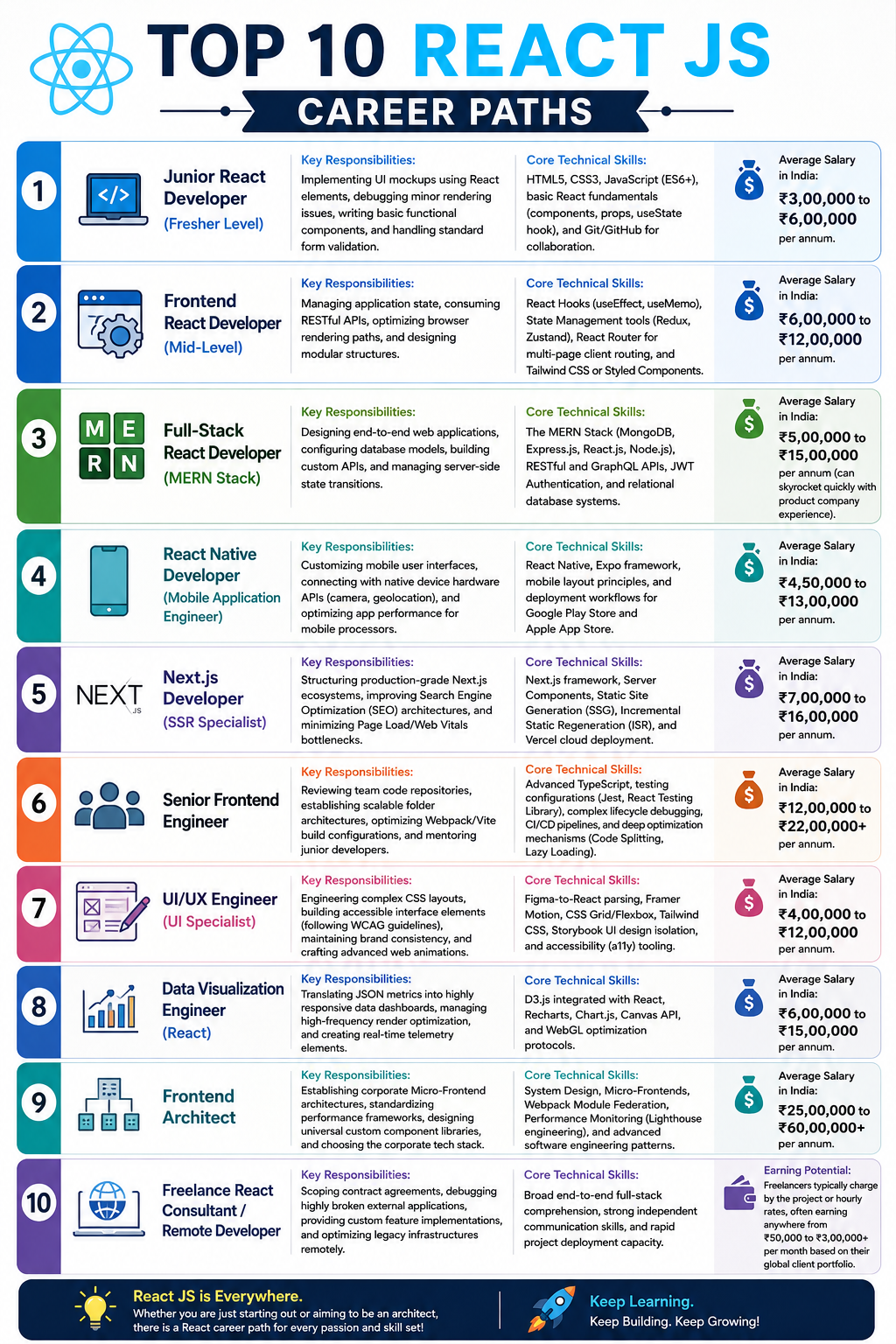
This is the standard entry point for fresh graduates or self-taught individuals who have just completed their foundational training. As a junior developer, you will work closely under the guidance of senior engineers to understand production-level code.
-
Key Responsibilities: Implementing UI mockups using React elements, debugging minor rendering issues, writing basic functional components, and handling standard form validation.
-
Core Technical Skills: HTML5, CSS3, JavaScript (ES6+), basic React fundamentals (components, props, useState hook), and Git/GitHub for collaboration.
-
Average Salary in India: ₹3,00,000 to ₹6,00,000 per annum.
2. Frontend React Developer (Mid-Level)
With 1 to 3 years of hands-on industry experience, you step into the core frontend developer role. Here, you transition from simply coding simple components to managing complete client-side features independently.
-
Key Responsibilities: Managing application state, consuming RESTful APIs, optimizing browser rendering paths, and designing modular structures.
-
Core Technical Skills: React Hooks (
useEffect,useMemo), State Management tools (Redux, Zustand), React Router for multi-page client routing, and Tailwind CSS or Styled Components. -
Average Salary in India: ₹6,00,000 to ₹12,00,000 per annum.
3. Full-Stack React Developer (MERN Stack)
Many businesses prefer engineers who can bridge the gap between front-end visuals and backend data management. By pairing React with Node.js, you become a highly sought-after Full-Stack Developer.
-
Key Responsibilities: Designing end-to-end web applications, configuring database models, building custom APIs, and managing server-side state transitions.
-
Core Technical Skills: The MERN Stack (MongoDB, Express.js, React.js, Node.js), RESTful and GraphQL APIs, JWT Authentication, and relational database systems.
-
Average Salary in India: ₹5,00,000 to ₹15,00,000 per annum (can skyrocket quickly with product company experience).
4. React Native Developer (Mobile Application Engineer)
One of React’s greatest superpowers is its cross-platform adaptation via React Native. If you prefer mobile ecosystem development over traditional web browsers, this career path lets you deploy apps on both iOS and Android platforms with a single codebase.
-
Key Responsibilities: Customizing mobile user interfaces, connecting with native device hardware APIs (camera, geolocation), and optimizing app performance for mobile processors.
-
Core Technical Skills: React Native, Expo framework, mobile layout principles, and deployment workflows for Google Play Store and Apple App Store.
-
Average Salary in India: ₹4,50,000 to ₹13,00,000 per annum.
5. Next.js Developer (SSR Specialist)
While basic React renders applications on the client’s browser, large enterprise platforms require search-engine-optimized, lightning-fast rendering. Next.js is a powerful meta-framework built on top of React that handles Server-Side Rendering (SSR).
-
Key Responsibilities: Structuring production-grade Next.js ecosystems, improving Search Engine Optimization (SEO) architectures, and minimizing Page Load/Web Vitals bottlenecks.
-
Core Technical Skills: Next.js framework, Server Components, Static Site Generation (SSG), Incremental Static Regeneration (ISR), and Vercel cloud deployment.
-
Average Salary in India: ₹7,00,000 to ₹16,00,000 per annum.
6. Senior Frontend Engineer
With 5+ years of dedicated technical experience, you transition into a leadership-oriented engineering role. Senior developers write less boilerplate code and focus heavily on complex system health, architecture, and code hygiene.
-
Key Responsibilities: Reviewing team code repositories, establishing scalable folder architectures, optimizing Webpack/Vite build configurations, and mentoring junior developers.
-
Core Technical Skills: Advanced TypeScript, testing configurations (Jest, React Testing Library), complex lifecycle debugging, CI/CD pipelines, and deep optimization mechanisms (Code Splitting, Lazy Loading).
-
Average Salary in India: ₹12,00,000 to ₹22,00,000+ per annum.
7. UI/UX Engineer (UI Specialist)
This unique career path blends artistic UI/UX design thinking with strong technical execution. A UI Engineering specialist transforms complex wireframes into hyper-polished, highly accessible interactive web layers.
-
Key Responsibilities: Engineering complex CSS layouts, building accessible interface elements (following WCAG guidelines), maintaining brand consistency, and crafting advanced web animations.
-
Core Technical Skills: Figma-to-React parsing, Framer Motion, CSS Grid/Flexbox, Tailwind CSS, Storybook UI design isolation, and accessibility (a11y) tooling.
-
Average Salary in India: ₹4,00,000 to ₹12,00,000 per annum.
8. Data Visualization Engineer (React)
In fintech, SaaS dashboard tracking, analytics, and healthcare systems, presenting millions of data points visually is critical. Data Visualization Engineers specialize in binding massive streams of information into interactive graphs.
-
Key Responsibilities: Translating JSON metrics into highly responsive data dashboards, managing high-frequency render optimization, and creating real-time telemetry elements.
-
Core Technical Skills: D3.js integrated with React, Recharts, Chart.js, Canvas API, and WebGL optimization protocols.
-
Average Salary in India: ₹6,00,000 to ₹15,00,000 per annum.
9. Frontend Architect
This is one of the highest echelons of the technical hierarchy. As an architect, you do not focus on single features; instead, you build the core technical infrastructure, internal tools, and design languages that power hundreds of applications across an entire enterprise.
-
Key Responsibilities: Establishing corporate Micro-Frontend architectures, standardizing performance frameworks, designing universal custom component libraries, and choosing the corporate tech stack.
-
Core Technical Skills: System Design, Micro-Frontends, Webpack Module Federation, Performance Monitoring (Lighthouse engineering), and advanced software engineering patterns.
-
Average Salary in India: ₹25,00,000 to ₹60,00,000+ per annum.
10. Freelance React Consultant / Remote Developer
Because of React’s vast international ecosystem, many companies look for external specialists to audit codebases, set up initial project pipelines, or complete discrete application cycles without hiring full-time, internal teams.
-
Key Responsibilities: Scoping contract agreements, debugging highly broken external applications, providing custom feature implementations, and optimizing legacy infrastructures remotely.
-
Core Technical Skills: Broad end-to-end full-stack comprehension, strong independent communication skills, and rapid project deployment capacity.
-
Earning Potential: Freelancers typically charge by the project or hourly rates, often earning anywhere from ₹50,000 to ₹3,00,000+ per month based on their global client portfolio.
Factors Affecting React.js Developer Salaries in India
Your career trajectory and earning potential will depend heavily on four overarching pillars:
-
Experience and Portfolio Quality: Theoretical knowledge is no longer enough to land high-paying roles. Employers look for developers who can showcase tangible engineering proof. Building real-world interfaces—such as comprehensive React JS projects for final year students or freshers—gives you a massive competitive advantage.
-
Technical Mastery (TypeScript & Next.js): Moving beyond vanilla JavaScript into highly typed configurations (TypeScript) and server environments (Next.js) immediately increases your market value.
-
Company Profiling: Product-focused companies (SaaS, FinTech, E-commerce) generally offer much higher salary tiers and stock structures compared to traditional IT service organizations.
-
Geographic Tech Hubs: Silicon Valley-style metros like Bangalore, Hyderabad, and Delhi-NCR feature the highest concentration of open job listings and offer premium compensation packages.
How to Start Your React.js Career Journey
If you want to transition successfully into any of the career paths listed above, following a structured learning roadmap is essential.
-
Step 1: Master Frontend Fundamentals: You cannot write clean React without a rock-solid understanding of semantic HTML, CSS styling, and Data-driven JavaScript logic (Asynchronous workflows, Arrays, Objects, and ES6 standard operations).
-
Step 2: Understand the React Paradigm: Deep dive into foundational structures—including JSX syntax, lifecycle Hooks, dynamic props passing, local component State tracking, and routing logic. Reviewing a structured React JS course syllabus can help you systematically track what skills you need to check off.
-
Step 3: Build Real-World Projects: Code dynamic personal portfolio websites, application management dashboards, or payment landing clones to sharpen your real-world deployment skills.
-
Step 4: Gain Industry-Recognized Mentorship: Self-directed study can leave gaps in your structural knowledge. Seeking professional mentoring through a comprehensive training program gives you the structured support needed to bridge the gap to professional engineering.
If you are eager to turn these career paths into your reality, explore the Codegnan React JS Training Course. Our practical program focuses heavily on hands-on deployment, building real-world software portfolios, and providing job placement support to help you smoothly transition into the tech industry.
Why Choose Codegnan for React JS Training?
Choosing where to learn React.js can make or break your transition into the tech industry. While online tutorials can teach you syntax, landing a high-paying job requires production-level engineering skills, a strong portfolio, and industry connections.
Codegnan bridges this gap by offering a comprehensive, job-oriented training ecosystem designed for students, freshers, and working professionals.
Here is why thousands of aspiring developers trust Codegnan for their tech careers:
-
Learn from Industry Experts: At Codegnan, you don’t learn from traditional academicians. Our instructors are experienced software engineers and consultants who bring real-world development insights, best practices, and enterprise-level coding standards directly into the classroom.
-
Practical, Project-Based Curriculum: We don’t believe in rote memorization. Our curriculum is deeply rooted in practical execution. You will spend your time building real-world applications, single-page dashboards, and dynamic UI layers, ensuring you leave with a comprehensive portfolio to show top employers.
-
100% Placement Assistance: We don’t just teach you how to code; we help you get hired. Codegnan features a dedicated placement cell that assists with resume building, LinkedIn optimization, mock interviews, and connects you directly with our network of over 1,200+ hiring partner companies across India.
-
Flexible Learning Modes: Whether you prefer the energy of interactive classroom training at our state-of-the-art tech hubs (in Hyderabad, Vijayawada, and Bengaluru) or the convenience of live online instructor-led sessions, we provide seamless options tailored to your schedule.
-
Trusted Authority in Tech Education: Codegnan has successfully trained over 30,000+ students with an exceptional average rating of 4.8/5. Our alumni are currently working at prestigious IT giants and fast-growing startups, proving the real-world value of our certification.
Don’t just learn React—master it in a professional ecosystem that prioritizes your career growth.
👉 Explore the Codegnan React JS Training Course today, download the detailed curriculum, and take your first step toward becoming a high-earning frontend engineer!
FAQs
1. Is React JS a good career path for freshers in India?
Yes, React JS is an excellent career path for freshers. Due to the high demand for dynamic web and mobile applications, product companies, startups, and IT services firms heavily recruit entry-level Junior React Developers. Starting with a solid understanding of JavaScript and React fundamentals allows freshers to secure competitive starting packages and quick career progression.
2. What is the average salary of a React JS developer in India?
The average salary of a React JS developer in India ranges from ₹3,00,000 to ₹6,00,000 per annum for freshers (Junior Developers). Mid-level developers with 1–3 years of experience typically command between ₹6,00,000 and ₹12,00,000 per annum, while Senior React Engineers and Architects can earn anywhere from ₹15,00,000 to over ₹30,00,000 per annum depending on their expertise and the hiring company.
3. Can I learn React JS without knowing advanced JavaScript?
It is highly discouraged to skip JavaScript. React is a JavaScript library, not a standalone language. To learn and use React effectively, you must have a strong grasp of core JavaScript concepts, specifically modern ES6+ features like arrow functions, destructuring, array methods (map, filter, reduce), modules, and asynchronous programming (Promises, Async/Await).
4. What is the difference between a React Developer and a MERN Stack Developer?
A React Developer focuses primarily on client-side frontend development, building user interfaces and handling browser-based state. A MERN Stack Developer is a full-stack engineer who uses React for the frontend but also builds and manages the backend infrastructure using MongoDB (Database), Express.js (Backend Framework), and Node.js (Runtime Environment).
5. Does React JS require coding or UI/UX design skills?
React JS is a code-intensive frontend library that requires strong programming logic in JavaScript. While React developers work closely with UI/UX designers to translate visual mockups into functional web layouts, they are not typically expected to design the assets themselves. However, having basic design empathy and familiarity with tools like Figma is a valuable asset.
6. Is Angular better or React JS for career growth?
Both frameworks have massive markets, but React JS currently holds a larger market share and a higher volume of open job listings globally. React’s component-based architecture, lighter learning curve, and versatility (with React Native for mobile and Next.js for SSR) often make it a more flexible choice for long-term career agility across startups and enterprise applications alike.
7. What skills are needed to become a Senior React Developer?
Beyond foundational React hooks and state management (like Redux or Zustand), a Senior React Developer needs mastery in TypeScript, performance optimization techniques (code splitting, lazy loading), advanced testing methodologies (Jest, React Testing Library), CI/CD deployment pipelines, system design architecture, and team mentorship.
8. Can I get a remote job as a freelance React Developer?
Absolutely. React’s massive global ecosystem makes it one of the top frameworks sought after by international clients on platforms like Upwork, Toptal, and Turing. Many companies prefer hiring remote freelance React consultants to audit existing codebases, optimize performance, or build custom minimum viable products (MVPs).
9. Why is Next.js often required alongside React JS?
While standard React renders applications directly in the user’s browser (Client-Side Rendering), this setup can sometimes face SEO indexing delays and slower initial page loads. Next.js is a powerful framework built on top of React that introduces Server-Side Rendering (SSR) and Static Site Generation (SSG), making web applications fast, high-performing, and search-engine friendly.
10. How long does it take to learn React JS and get a job?
For an individual with a pre-existing foundation in HTML, CSS, and basic JavaScript, it typically takes 3 to 6 months of dedicated, hands-on practice to become proficient in React JS. Building a structured portfolio of real-world projects and completing an industry-aligned training certification can significantly accelerate the job placement timeline.