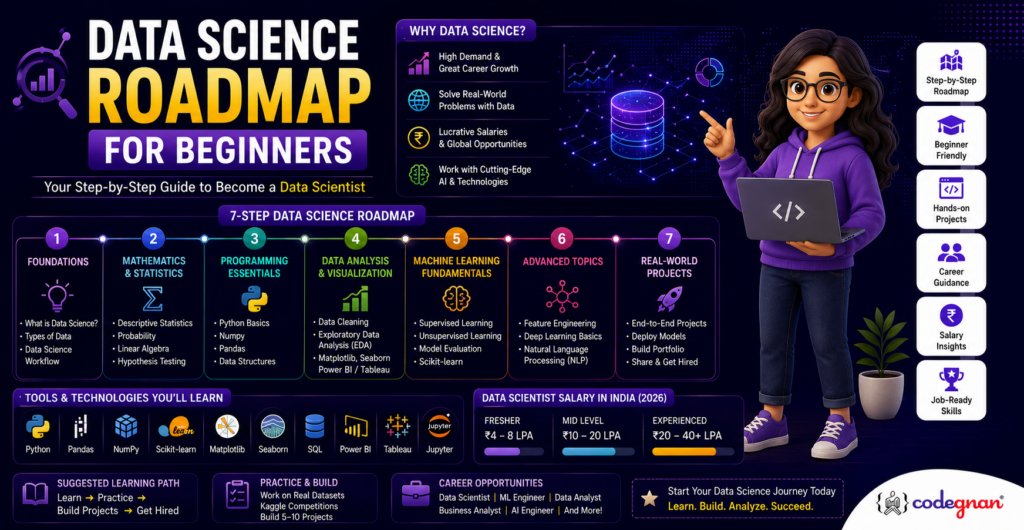



Quick Answer: The Data Science roadmap for beginners in 2026 starts with Python and SQL, moves through statistics, data analysis, and visualization, then covers machine learning, deep learning, and NLP. Add big data, MLOps, and cloud basics, build real projects, and you can become job-ready in 6 to 12 months.
Data science continues to be one of the most rewarding career paths in 2026, with demand growing fast as companies build AI-powered products and lean on data for every major decision. But most beginners get stuck not because the field is too hard, but because there is no clear order to learn things in. This guide lays out a complete, step-by-step data science roadmap, from your very first Python script to your first job offer, so you always know what to learn next. If you want a structured, mentor-led version of this exact path, Codegnan’s Data Science course covers every step below with real projects and placement support.
What Is Data Science?
Data science is the practice of extracting insights and predictions from raw data using programming, statistics, and domain knowledge. It combines coding, mathematics, and business thinking to help organizations make better decisions, whether that means predicting customer churn, detecting fraud, or powering a recommendation engine.
Roles & Responsibilities
A data scientist typically collects and cleans data, explores it to find patterns, builds and evaluates machine learning models, and communicates findings to stakeholders through dashboards, reports, or presentations. The role sits at the intersection of coding, statistics, and storytelling, so strong technical skills alone are rarely enough. You also need to explain what the numbers mean to people who don’t work with data every day.
Data Science vs Data Analytics vs Machine Learning
These three terms are often used interchangeably, but they are not the same. Data analytics focuses on examining past data to answer specific business questions, usually through dashboards and reports. Data science goes further, using statistics and machine learning to build predictive models and uncover patterns that aren’t obvious from a simple report. Machine learning is a subset of data science focused specifically on building algorithms that learn from data and improve their predictions over time. In short, analytics looks backward, data science looks both backward and forward, and machine learning is the engine that powers the forward-looking part.
Why Learn Data Science in 2026?
Every industry, from healthcare to fintech to e-commerce, now runs on data, and the rise of generative AI has only increased demand for professionals who can work with data, build models, and understand how AI systems actually function. Data scientists with GenAI and LLM skills are already earning noticeably more than those with only traditional machine learning experience, and that gap is expected to widen through 2026 and beyond. For beginners, this means the earlier you build a solid foundation, the more of this growing demand you can capture.
Data Science Roadmap (Step-by-Step)
Step 1: Learn Programming
Programming is the entry point into data science, and you don’t need to master everything at once. Start with the basics and build up gradually as you apply each skill to real problems.
- Python: The default language for data science because of its simplicity and its enormous ecosystem of libraries. Focus on variables, loops, functions, and object-oriented basics before moving to data libraries. Codegnan’s online Python course is a good starting point if you’re learning from scratch.
- SQL: Nearly every data science role requires pulling and shaping data from databases, so SQL is non-negotiable. Learn SELECT statements, joins, aggregations, and subqueries early.
- Git & GitHub: Version control is how you track your work and, later, how recruiters will judge your projects. Learn basic commits, branches, and how to push a project to a public repository.
Step 2: Mathematics & Statistics
Math is the part beginners fear most, but you only need a working understanding, not a research-level mastery, to get started.
- Linear Algebra: Vectors, matrices, and matrix operations underpin how machine learning models process data internally.
- Probability: Core to understanding uncertainty, distributions, and how models make predictions.
- Statistics: Descriptive statistics, correlation, and distributions help you understand your data before you model it.
- Calculus: A basic grasp of derivatives is enough to understand how models like linear regression and neural networks optimize themselves.
- Hypothesis Testing: Essential for A/B testing and validating whether a pattern in your data is real or just noise.
Step 3: Data Analysis
This is where you start actually working with real datasets and turning raw numbers into something usable.
- NumPy: The foundation for numerical computing in Python, used for fast array operations.
- Pandas: The most-used library for loading, cleaning, and manipulating tabular data.
- Data Cleaning: Handling missing values, duplicates, and inconsistent formatting, often the most time-consuming part of any real project.
- Exploratory Data Analysis (EDA): Using summary statistics and visualizations to understand a dataset before building any model.
Step 4: Data Visualization
Being able to communicate findings visually is just as important as finding them in the first place.
- Matplotlib: Python’s foundational plotting library, useful for full control over chart details.
- Plotly: Great for interactive, web-ready visualizations.
- Seaborn: Built on top of Matplotlib, ideal for statistical plots with cleaner defaults.
- Tableau: A widely used business intelligence tool for building dashboards without heavy coding.
- Power BI: Microsoft’s BI tool, commonly required in corporate and enterprise data roles.
Step 5: Machine Learning
This is where data science starts to feel like the field most beginners imagined when they signed up.
- Regression: Predicting continuous values, like house prices or sales figures.
- Classification: Predicting categories, like whether an email is spam or a transaction is fraudulent.
- Clustering: Grouping similar data points together without labeled outcomes, used in customer segmentation.
- Model Evaluation: Metrics like accuracy, precision, recall, and RMSE that tell you whether your model is actually good.
- Feature Engineering: Creating and selecting the right input variables, often the single biggest factor separating a mediocre model from a great one. Codegnan’s Machine Learning course walks through all of these concepts with hands-on projects.
Step 6: Deep Learning
Once you’re comfortable with traditional machine learning, deep learning opens the door to more complex problems like images, audio, and language.
- Neural Networks: The foundational architecture behind all deep learning models.
- CNNs: Convolutional Neural Networks, used mainly for image recognition and computer vision tasks.
- RNNs: Recurrent Neural Networks, historically used for sequential data like time series and text.
- Transformers: The architecture behind modern large language models, now the backbone of most state-of-the-art AI systems.
Step 7: NLP
Natural Language Processing lets you work with one of the fastest-growing areas of data science today, powered largely by the rise of generative AI.
- Text Processing: Tokenization, stemming, and cleaning raw text before analysis.
- Sentiment Analysis: Classifying text as positive, negative, or neutral, a common beginner-friendly NLP project.
- Chatbots: Building rule-based or model-driven conversational systems.
- LLM Basics: Understanding how large language models like GPT work, including prompting, embeddings, and basic fine-tuning concepts.
Step 8: Big Data
As datasets grow beyond what a single machine can handle, big data tools become essential, particularly for data scientists working at larger companies.
- Spark: A distributed computing framework for processing massive datasets quickly.
- Hadoop: An older but still widely used framework for distributed storage and processing.
- Kafka: A tool for handling real-time data streams, common in companies that need live analytics.
Step 9: MLOps
MLOps is what turns a model in a notebook into something that actually runs in production, and it’s an increasingly expected skill for data scientists in 2026.
- Docker: Packaging your model and its dependencies so it runs consistently anywhere.
- Kubernetes: Managing and scaling containerized applications in production environments.
- MLflow: Tracking experiments, model versions, and deployments.
- CI/CD: Automating testing and deployment pipelines so models can be updated safely and quickly.
Step 10: Cloud Platforms
Most companies now run their data infrastructure and models on the cloud, so basic cloud fluency is a strong differentiator for job seekers.
- AWS: The most widely used cloud platform, with services like SageMaker for building and deploying ML models.
- Azure: Popular in enterprise environments, with strong integration into Microsoft’s existing tools.
- Google Cloud: Known for its Vertex AI platform and strong data engineering tools like BigQuery.
Essential Data Science Skills
Technical Skills: Python, SQL, statistics, machine learning, data visualization, and increasingly, cloud and MLOps basics.
Soft Skills: Clear communication, storytelling with data, curiosity, and the ability to break down ambiguous business problems into solvable technical ones.
Business Skills: Understanding the industry you work in, translating model outputs into business impact, and knowing which metrics actually matter to stakeholders.
Data Science Learning Timeline
| Timeline | Skills to Learn |
|---|---|
| Month 1 to 2 | Python, SQL, Git basics |
| Month 3 | Statistics, probability, EDA |
| Month 4 | Data visualization, Pandas, NumPy |
| Month 5 to 6 | Machine learning algorithms and projects |
| Month 7 to 8 | Deep learning and NLP fundamentals |
| Month 9 | Big data and cloud basics |
| Month 10 | MLOps fundamentals |
| Month 11 to 12 | Portfolio building, interview prep, job applications |
Data Science Tech Stack
| Category | Tools |
|---|---|
| Programming | Python, SQL, R |
| Data Analysis | Pandas, NumPy |
| Visualization | Matplotlib, Seaborn, Plotly, Tableau, Power BI |
| Machine Learning | Scikit-learn, XGBoost |
| Deep Learning | TensorFlow, PyTorch |
| NLP | NLTK, spaCy, Hugging Face Transformers |
| Big Data | Spark, Hadoop, Kafka |
| MLOps | Docker, Kubernetes, MLflow |
| Cloud | AWS, Azure, Google Cloud |
Best Data Science Projects
Projects are what actually convince recruiters you can do the job, so treat this section as mandatory, not optional.
Beginner
- Titanic Survival Prediction: A classic classification project that teaches the basics of the ML workflow, from cleaning to prediction.
- House Price Prediction: A regression project that introduces feature engineering and model evaluation.
- Movie Recommendation System: Builds foundational understanding of similarity metrics and recommendation logic.
Intermediate
- Customer Churn Prediction: A business-relevant classification problem widely used across telecom, SaaS, and subscription industries.
- Sales Forecasting: A time-series project that introduces trend and seasonality analysis.
- Credit Risk Analysis: Teaches how to work with imbalanced datasets and financial data.
Advanced
- Fraud Detection: Combines imbalanced classification with real-world business stakes, a strong resume project for fintech roles.
- Resume Screening: An NLP project that applies text classification to a genuinely useful HR problem.
- RAG-based Chatbot: Demonstrates practical experience with retrieval-augmented generation, one of the most in-demand GenAI skills in 2026.
- AI Recommendation Engine: A more advanced take on recommendation systems using embeddings or deep learning.
For a longer list with step-by-step guidance, Codegnan’s beginner’s guide to data science projects walks through 15 project ideas suited to different skill levels.
Data Science Career Path
The typical career path in data science runs from Data Analyst to Junior Data Scientist to Data Scientist to Senior Data Scientist to Lead Data Scientist, with many professionals eventually branching into AI/ML Engineer roles or, at the top of the ladder, Chief Data Officer positions. Not everyone follows this exact order. Some start directly in a junior data scientist role after a strong project portfolio, while others move sideways from software engineering or analytics roles once they’ve built up the right skillset.
- Data Analyst
- Junior Data Scientist
- Data Scientist
- Senior Data Scientist
- Lead Data Scientist
- AI/ML Engineer
- Chief Data Officer
Data Scientist Salary
India
The average data scientist salary in India in 2026 is approximately 11 to 15 LPA, though this varies widely across sources. Entry-level roles typically start between 4 and 8 LPA, mid-level professionals with 4 to 9 years of experience earn 10 to 20 LPA, and senior data scientists at top companies can cross 30 to 40 LPA. Data scientists with GenAI and LLM skills in 2026 are earning noticeably more, often 25 to 50 percent above generalist data scientists with only traditional machine learning experience.
USA
In the United States, the average data scientist base salary in 2026 sits between roughly 120,000 and 130,000 dollars per year, with total compensation (including bonuses) commonly reaching 145,000 dollars or more. At top tech companies, mid-level data scientists can see total compensation exceed 160,000 dollars, and senior or principal-level roles at major firms can cross 300,000 dollars.
Experience-wise Salary
Fresher data scientists in India typically start around 5 to 8 LPA, professionals with 1 to 4 years of experience earn roughly 8 to 12 LPA, mid-level professionals with 4 to 9 years earn 12 to 20 LPA, and senior professionals with a decade or more of experience can earn well beyond 30 LPA, particularly at product companies and global tech firms.
Salary by Skills
Skills that add the biggest salary premium in 2026 include generative AI and LLM experience, cloud platforms, MLOps, and deep learning specialization. Traditional skills like SQL and basic machine learning remain necessary but no longer command a significant premium on their own, since nearly every candidate now has them.
Certifications
Certifications won’t replace real project experience, but they help validate your skills to recruiters, especially early in your career.
- Google: The Google Data Analytics and Google Advanced Data Analytics certificates are well-regarded, beginner-friendly entry points.
- IBM: The IBM Data Science Professional Certificate covers Python, SQL, and machine learning in a structured format.
- Microsoft: Azure Data Scientist Associate is useful if you’re aiming for enterprise or Microsoft-heavy environments.
- AWS: The AWS Certified Machine Learning Specialty certification is valuable for cloud-focused ML roles.
- DeepLearning.AI: Andrew Ng’s deep learning and machine learning specializations are widely respected and cover strong theoretical foundations.
Data Science Interview Preparation
Python Questions: Expect questions on data structures, list comprehensions, functions, and how you’d use Pandas to solve a specific data manipulation problem.
SQL Questions: Practice joins, window functions, group by logic, and query optimization, since these come up in nearly every data science interview.
Statistics Questions: Be ready to explain concepts like p-values, confidence intervals, distributions, and how you’d design an A/B test.
Machine Learning Questions: Expect questions on bias-variance tradeoff, overfitting, model evaluation metrics, and when you’d choose one algorithm over another.
Case Studies: Many interviews include an open-ended business case, such as “how would you reduce customer churn,” where interviewers care more about your reasoning process than a single correct answer.
Best Resources to Learn
Free Courses: Kaggle Learn, Google’s free Data Analytics courses, and freeCodeCamp all offer strong, no-cost starting points.
Books: “Python for Data Analysis” by Wes McKinney and “An Introduction to Statistical Learning” are both widely recommended for building strong fundamentals.
YouTube Channels: Channels like StatQuest for statistics and machine learning concepts, and Corey Schafer for Python fundamentals, are popular among self-taught data scientists.
Documentation: Official documentation for Pandas, Scikit-learn, and TensorFlow is often clearer and more current than most tutorials, and it’s a habit worth building early.
Common Mistakes Beginners Make
Many beginners jump straight into machine learning without a solid grasp of Python, SQL, or statistics, which leads to models they don’t actually understand. Others focus entirely on watching tutorials without ever building an original project, which leaves them with no portfolio when it’s time to apply for jobs. A common third mistake is trying to learn everything on this roadmap at once instead of following it step by step, which usually leads to burnout rather than progress. Finally, many beginners skip communication and business context entirely, forgetting that a data scientist’s job isn’t just to build a model, but to explain what it means and why it matters.
Future Trends in Data Science
Generative AI: GenAI tools are being embedded into data workflows themselves, from automated EDA to AI-assisted feature engineering, changing how data scientists work day to day.
LLMs: Large language models are becoming core infrastructure, and understanding how to fine-tune, prompt, and evaluate them is now a baseline expectation in many roles.
AI Agents: Autonomous agents that can plan and execute multi-step data tasks are an emerging area, and early familiarity with agent frameworks is likely to be a strong differentiator.
AutoML: Tools that automate model selection and tuning are reducing the need for manual experimentation on routine problems, shifting data scientist time toward more strategic work.
Responsible AI: As AI systems get deployed more widely, skills in fairness, explainability, and bias detection are becoming a genuine hiring requirement rather than a nice-to-have.
Resume & Portfolio Guide
GitHub Portfolio: Keep 3 to 5 well-documented projects on GitHub, each with a clear README explaining the problem, your approach, and your results. Quality matters far more than quantity here.
Kaggle Profile: Participating in Kaggle competitions, even without winning, demonstrates hands-on experience with real, messy datasets and is a strong signal to recruiters.
LinkedIn Optimization: Use a clear headline describing your target role, list your projects and skills explicitly, and share occasional posts about what you’re learning to build visibility in the data science community.
If you’d rather follow this roadmap with structured mentorship, real projects, and placement support instead of piecing it together alone, Codegnan’s Data Science course and Machine Learning course are available across Hyderabad, Bangalore, and online.
FAQs
1. What is the best roadmap to learn Data Science?
Start with Python and SQL, build a foundation in statistics, move through data analysis and visualization, then learn machine learning, deep learning, and NLP, adding big data, MLOps, and cloud skills as you advance.
2. How long does it take to become a Data Scientist?
Most beginners can become job-ready in 6 to 12 months with consistent daily practice, though the exact timeline depends on your starting point and how much time you can dedicate each week.
3. Is Python mandatory for Data Science?
Yes, Python is the industry-standard language for data science due to its simplicity and extensive ecosystem of libraries like Pandas, NumPy, and Scikit-learn.
4. What skills are required for Data Science?
Core skills include Python, SQL, statistics, machine learning, and data visualization, alongside soft skills like communication and business understanding.
5. What are the best Data Science projects for beginners?
Titanic Survival Prediction, House Price Prediction, and Movie Recommendation Systems are strong beginner projects that teach the full machine learning workflow.
6. What is the average Data Scientist salary in India?
The average data scientist salary in India in 2026 is approximately 11 to 15 LPA, with entry-level roles starting around 5 to 8 LPA and senior roles crossing 30 LPA or more.
7. Which certifications are best for Data Science?
Google’s Data Analytics certificate, IBM’s Data Science Professional Certificate, and DeepLearning.AI’s machine learning specializations are all well-regarded starting points.
8. What is the difference between Data Science and Machine Learning?
Data science is the broader field covering data analysis, statistics, and modeling, while machine learning is a specific subset focused on building algorithms that learn patterns from data.
9. How do I prepare for Data Science interviews?
Practice Python and SQL coding problems, review core statistics and machine learning concepts, and prepare to walk through your own projects and business case studies in detail.
10. Is Data Science a good career in 2026?
Yes, data science remains a high-demand, high-paying career in 2026, with the rise of generative AI further increasing the value of professionals who can combine data skills with AI fluency.