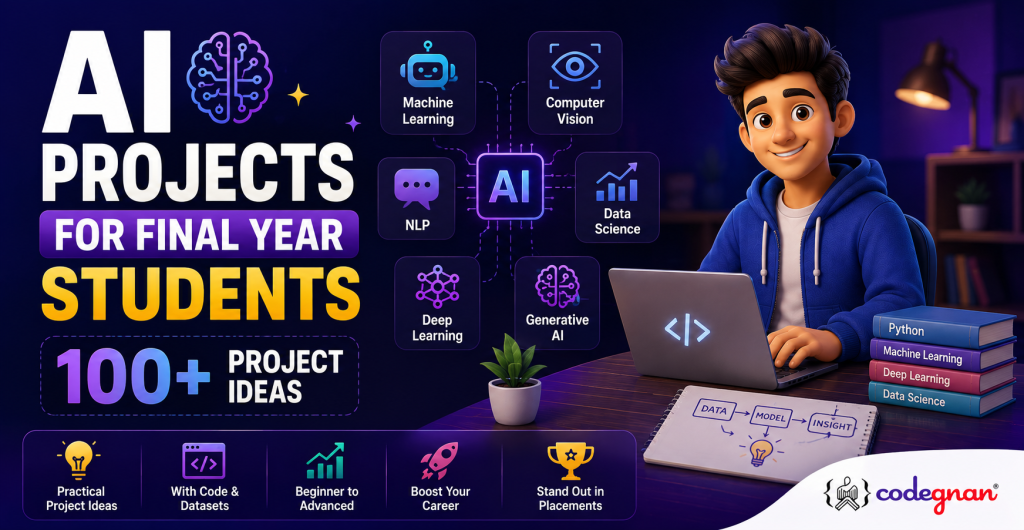





Artificial Intelligence has moved from being a niche specialization to becoming the single most in-demand skill for engineering, MCA, and BTech graduates in 2026. Recruiters no longer just check your CGPA or your degree certificate. They check your GitHub, your Kaggle profile, and most importantly, the AI projects you have built and shipped on your own.
If you are a final year student wondering what project to pick for your major project submission, this guide gives you more than 100 AI project ideas across every difficulty level, from beginner-friendly machine learning models to advanced generative AI and LLM-based systems that mirror what companies are actually building right now.
Whether you are pursuing a BTech, MCA, or any computer science related degree, this list is designed to help you choose a project that not only satisfies your college’s final year project requirement but also becomes a genuine talking point in your placement interviews.
Why Final Year Students Should Build AI Projects
A final year AI project is no longer just an academic formality. It has become one of the strongest signals a hiring manager looks for when evaluating fresh graduates. Here is why building a solid AI project matters more than most students realize.
Better placements. Companies hiring for AI, data science, and software roles increasingly ask candidates to walk through a real project during interviews. A well-built AI project gives you something concrete to discuss instead of relying purely on theoretical answers.
A stronger portfolio. A project that solves a real problem, even a small one, demonstrates that you can take an idea from concept to execution. This is far more convincing to a recruiter than a list of completed courses.
A credible GitHub profile. Recruiters and technical interviewers frequently look at GitHub before or during an interview. A clean repository with proper documentation, commit history, and a working demo tells them you can write production-style code, not just notebook experiments.
Kaggle experience. Participating in Kaggle competitions or using Kaggle datasets for your final year project shows that you understand real-world, messy data rather than only clean textbook datasets.
Higher starting salary. Students who can demonstrate applied AI skills, especially around machine learning, deep learning, or generative AI, often negotiate better offers because they reduce the training cost for the employer.
Internship opportunities. A strong project built during your final year can double up as a portfolio piece for internship applications, research assistantships, or even freelance AI development work.
If you want to build this foundation properly rather than learning AI concepts in isolation, a structured AI course in Hyderabad can help you move from Python basics to real project development with proper mentorship.
100+ AI Projects for Final Year Students
Below is a categorized list of AI project ideas, organized by difficulty level so you can pick something that matches your current skill level and the time you have available before submission.
1. Beginner AI Projects (20 Ideas)
These projects are ideal if you are just starting out with machine learning and want to build confidence with the end-to-end workflow: data collection, cleaning, model training, and evaluation.
- Spam Detection using Naive Bayes
- Email Classifier (Primary, Social, Promotions)
- Movie Recommendation System
- Student Performance Prediction
- House Price Prediction
- Resume Screening System
- Weather Prediction Model
- Loan Approval Prediction
- Fake News Detection
- Handwritten Digit Recognition (MNIST)
- Iris Flower Classification
- Sentiment Analysis on Product Reviews
- Titanic Survival Prediction
- Credit Card Fraud Flagging (basic model)
- Diabetes Prediction using ML
- Sales Forecasting for Retail
- Customer Segmentation using Clustering
- Basic Chatbot using Rule-Based Logic
- Image Classification with a Pretrained CNN
- Simple Recommendation Engine for E-commerce
These projects are excellent for students building their first portfolio piece. If you want a guided path through the fundamentals before attempting these, Codegnan’s Python training course in Hyderabad covers the programming groundwork most beginner AI projects require.
2. Intermediate AI Projects (25 Ideas)
Once you are comfortable with the basics, these projects push you into computer vision, speech, and more involved model pipelines.
- Face Recognition Attendance System
- Emotion Detection from Facial Expressions
- Vehicle Detection and Counting System
- OCR System for Document Digitization
- Speech Recognition System
- AI-Based Attendance System
- Customer Churn Prediction
- Stock Price Prediction using LSTM
- Plant Disease Detection using Image Classification
- AI Chatbot with Intent Recognition
- Object Detection using YOLO
- Traffic Sign Recognition
- Handwriting to Text Conversion
- Music Genre Classification
- Language Translation Tool
- Text Summarization Tool
- Image Captioning System
- Recommendation System using Collaborative Filtering
- Air Quality Prediction Model
- Crop Yield Prediction using ML
- Sign Language Recognition
- AI-Powered Resume Parser
- Product Defect Detection using Computer Vision
- Human Activity Recognition
- AI-Based Personality Prediction from Text
Many of these projects require solid machine learning fundamentals combined with hands-on model deployment practice. Codegnan’s machine learning course in Hyderabad is structured around exactly this kind of applied, project-first learning.
3. Advanced AI Projects (25 Ideas)
These projects are suited for students who want to demonstrate deeper technical depth, often combining multiple AI domains such as computer vision, NLP, and reinforcement learning.
- AI Interview Assistant with Real-Time Feedback
- AI Coding Assistant
- Medical Diagnosis Prediction System
- Autonomous Drone Navigation
- AI Legal Assistant for Document Review
- AI Tutor for Personalized Learning
- AI Financial Advisor
- AI Voice Assistant
- Deepfake Detection System
- Fraud Detection using Anomaly Detection
- Self-Driving Car Simulation
- AI-Based Resume to Job Matching System
- Predictive Maintenance for Industrial Machines
- AI-Powered Cybersecurity Threat Detector
- Multimodal AI System (Text plus Image)
- Recommendation Engine with Deep Learning
- AI-Based Health Monitoring System using Wearable Data
- Real-Time Object Tracking System
- AI System for Crop Disease and Yield Optimization
- Reinforcement Learning based Game Agent
- AI-Based Video Surveillance and Anomaly Detection
- Neural Machine Translation System
- AI-Powered Virtual Try-On for E-commerce
- AI Model for Detecting Deepfake Audio
- Explainable AI Dashboard for Model Interpretability
4. Generative AI Projects (20 Ideas)
Generative AI has become the fastest-growing area of AI hiring in 2026. Projects here typically use large language models such as ChatGPT, Claude, or Gemini, along with frameworks like LangChain, CrewAI, and AutoGen, and techniques like retrieval augmented generation (RAG).
- PDF Chatbot using RAG
- AI Resume Builder
- AI Content Generator for Blogs and Social Media
- AI Research Assistant
- AI Code Reviewer
- AI Meeting Notes Generator
- AI Email Generator
- AI Healthcare Assistant Chatbot
- AI Customer Support Bot
- AI SQL Generator (Text to SQL)
- AI-Powered Study Companion
- AI Video Script Generator
- AI Image Generation Tool using Stable Diffusion
- AI Presentation Generator
- AI-Based Legal Document Summarizer
- Multi-Agent Research Assistant using CrewAI
- AI Customer Feedback Analyzer
- AI-Powered Interview Question Generator
- AI Product Description Generator for E-commerce
- Personal AI Assistant using Multiple Tool Calling
If generative AI is the direction you want to specialize in, Codegnan’s Applied Agentic AI course in Hyderabad covers LangChain, RAG, vector databases, and AI agent development in a hands-on, project-based format that maps directly onto the ideas above.
5. LLM Projects
Large Language Model (LLM) based projects are some of the most sought-after in current final year submissions because they combine software engineering with applied AI. Topics to cover in your project can include:
- Retrieval Augmented Generation (RAG) pipelines
- Text embeddings and semantic search
- Vector search using Pinecone, ChromaDB, or FAISS
- LangGraph for multi-step agent workflows
- Model Context Protocol (MCP) for tool integration
- Tool calling and function calling with LLMs
- Building autonomous AI agents
A strong LLM project idea for final year submission could be a document question-answering system built with RAG and a vector database, deployed as a working web application rather than just a notebook demo.
6. Domain-wise AI Projects
Choosing a domain-specific project can make your final year submission more relevant to a particular industry you want to work in. Here are project directions across major domains.
Healthcare: Disease prediction models, medical image classification, AI-based diagnostic assistants, patient readmission prediction.
Finance: Credit risk scoring, fraud detection, algorithmic trading bots, personal finance advisory chatbots.
Education: Adaptive learning platforms, automated grading systems, AI tutors, plagiarism detection tools.
Retail: Demand forecasting, personalized recommendation engines, inventory optimization, visual search for products.
Agriculture: Crop disease detection, yield prediction, soil quality analysis, irrigation optimization using AI.
Manufacturing: Predictive maintenance, defect detection on production lines, supply chain optimization.
HR: Resume screening automation, employee attrition prediction, AI-based interview scheduling assistants.
Cybersecurity: Intrusion detection systems, phishing detection, malware classification using ML.
IoT: Smart home automation with AI, anomaly detection in sensor data, predictive analytics for connected devices.
Smart Cities: Traffic flow prediction, smart parking systems, waste management optimization using computer vision.
Transportation: Route optimization, accident prediction models, fleet management using AI.
E-commerce: Personalized product recommendations, dynamic pricing models, customer sentiment analysis.
Trending AI Projects in 2026
If you want your final year project to feel current and relevant to what companies are hiring for right now, consider building around these trending themes.
- AI Agents that can plan, reason, and execute multi-step tasks autonomously
- Multi-Agent Systems where several specialized AI agents collaborate on a task
- Voice AI applications, including real-time voice assistants and voice cloning detection
- AI Coding Assistants that review, generate, or debug code
- AI Search Engines built with retrieval and ranking pipelines
- AI Recruiters that automate resume shortlisting and initial candidate screening
- AI Video Generators for short-form content creation
- AI Medical Assistants for symptom checking and preliminary diagnosis support
- AI Personal Tutors that adapt to a student’s pace and learning style
- AI Sales Assistants that qualify leads and draft outreach messages
These project categories are also good indicators of where the current AI job market is headed, so building even a simplified version of one of these can make your project stand out.
AI Projects by Technology
Different colleges and evaluators sometimes expect a project built around a specific technology stack. Here is a breakdown by tool and framework so you can align your project with your syllabus or personal interest.
AI Projects Using Python: Since Python is the primary language for almost all AI work, most of the projects listed above, including spam detection, recommendation systems, and chatbots, can be implemented purely in Python with libraries like scikit-learn, pandas, and NumPy.
AI Projects Using Machine Learning: Loan approval prediction, customer churn prediction, fraud detection, and stock price forecasting are strong choices to demonstrate classic ML skills such as regression, classification, and clustering.
AI Projects Using Deep Learning: Image captioning, handwriting recognition, and neural machine translation are good examples that showcase your understanding of neural networks, CNNs, and RNNs or transformers.
AI Projects Using NLP: Text summarization, sentiment analysis, fake news detection, and chatbot intent recognition are classic natural language processing projects that remain highly relevant.
AI Projects Using OpenCV: Face recognition, vehicle detection, and object tracking projects rely heavily on OpenCV for image processing and computer vision tasks.
AI Projects Using TensorFlow: Deep learning-heavy projects like plant disease detection or emotion detection are commonly built using TensorFlow and Keras.
AI Projects Using PyTorch: If your coursework leans more research-oriented, PyTorch is often preferred for projects involving custom neural network architectures, such as deepfake detection or GAN-based image generation.
AI Projects Using LLMs: PDF chatbots, AI research assistants, and text-to-SQL generators are examples of LLM-based projects that use APIs from providers like OpenAI, Anthropic, or open-source models.
AI Projects with Source Code: How to Structure Yours
When you build and document your final year AI project, it helps to present it the way a recruiter or evaluator would want to see it. Structuring your project documentation around the following table makes it far easier for anyone reviewing your GitHub repository to quickly understand what you built.
| Section | What to Include |
|---|---|
| Difficulty | Beginner, Intermediate, or Advanced |
| Technologies | Python, TensorFlow, OpenCV, LangChain, etc. |
| Skills Learned | Computer vision, NLP, machine learning, deployment |
| Estimated Time | 1 to 8 weeks depending on scope |
| Resume Impact | High, Medium, or Low |
| GitHub Worthiness | Rated out of 5 stars based on documentation and completeness |
| Placement Value | High, Medium, or Low based on current hiring trends |
A project that includes a clear README, a working demo (even a simple Streamlit or Flask app), and a short explanation of your design decisions will always outperform a project that is just a Jupyter notebook with no context.
How to Choose the Right AI Project
With more than 100 ideas above, picking just one can feel overwhelming. Use these five factors to narrow down your choice.
Skill level. Be honest about where you currently stand. If you have only just finished learning Python and basic ML concepts, an advanced multi-agent system will likely cause more frustration than learning. Start with something one level above your comfort zone.
Time available. A final year project usually has a fixed submission deadline. Beginner and intermediate projects can typically be completed in two to four weeks, while advanced or generative AI projects may take six to eight weeks including testing and documentation.
Domain interest. Choose a domain you genuinely care about, whether that is healthcare, finance, agriculture, or e-commerce. Projects in a domain you understand well are easier to explain convincingly in interviews.
Placement goals. If you are targeting roles in generative AI or AI engineering, prioritize LLM and agentic AI projects. If you are aiming for traditional data science or ML engineer roles, intermediate and advanced ML projects are more directly relevant.
Hardware requirements. Deep learning projects involving large models or datasets may need GPU access. Check whether you have access to Google Colab, Kaggle notebooks, or a college lab with GPU support before committing to a compute-heavy project.
AI Project Development Roadmap
Regardless of which project you choose, following a structured development process will make the difference between a project that looks rushed and one that looks professional.
- Problem Statement: Clearly define what problem your project solves and why it matters.
- Dataset Collection: Source your data from platforms like Kaggle, UCI, or Hugging Face, or collect it yourself if the project demands it.
- Data Cleaning: Handle missing values, duplicates, and inconsistent formatting before any modeling begins.
- Feature Engineering: Create or transform variables that improve your model’s ability to learn meaningful patterns.
- Model Selection: Choose an appropriate algorithm or architecture based on your problem type, whether that is classification, regression, or generation.
- Training: Train your model while tracking metrics to avoid overfitting or underfitting.
- Testing: Validate your model on unseen data and report honest performance numbers, not just the best run.
- Deployment: Wrap your model in a simple web app or API using Flask, FastAPI, or Streamlit so it is usable, not just runnable in a notebook.
- Documentation: Write a clear README explaining the problem, approach, results, and how to run the project.
- GitHub Publishing: Push clean, well-commented code with a proper commit history so your repository reflects real engineering practice.
Following this roadmap consistently is often what separates a project that impresses a recruiter from one that gets skipped over during a resume screen.
Datasets for AI Projects
Finding the right dataset is often the first real obstacle in building an AI project. Here are the most reliable sources.
- Kaggle: The largest collection of ready-to-use datasets and community notebooks, ideal for almost every project category listed above.
- UCI Machine Learning Repository: A long-standing academic source for structured datasets, particularly useful for classic ML projects.
- Hugging Face Datasets: A strong choice for NLP and LLM-based projects, offering text, audio, and multimodal datasets.
- Google Dataset Search: A search engine specifically for finding datasets across the web.
- OpenML: Useful for benchmarking machine learning models against standardized datasets.
- Data.gov: A good source for government and public sector data, particularly useful for smart city and civic-tech projects.
Tools Required for AI Projects
Before you start building, make sure your development environment includes the following tools.
- Python
- VS Code
- Jupyter Notebook
- TensorFlow
- PyTorch
- Scikit-learn
- OpenCV
- GitHub
- Docker
- FastAPI
- Flask
- Streamlit
- Google Colab
Most of these tools are free to use, and Google Colab in particular is a good starting point if you don’t have access to a GPU-equipped machine.
Career Opportunities After Building AI Projects
A strong portfolio of AI projects opens doors to a wide range of roles, including:
- AI Engineer
- Machine Learning Engineer
- Data Scientist
- Generative AI Engineer
- Prompt Engineer
- Computer Vision Engineer
- NLP Engineer
- Research Scientist
- AI Product Engineer
- MLOps Engineer
Each of these roles values hands-on project experience as much as, if not more than, academic performance. If you are exploring which career path fits you best, Codegnan’s Data Science course in Hyderabad is a good next step for structured, mentor-led learning across Python, ML, and data visualization, while students interested in full-stack development alongside AI can explore the Python Full Stack Developer course for a broader skill set.
Common Mistakes Final Year Students Make with AI Projects
Even with a strong project idea, execution mistakes can weaken your final submission and hurt your chances during placement interviews. Here are the most common ones to avoid.
Picking a project that is too ambitious for the timeline. It is tempting to choose something impressive-sounding like an autonomous drone system or a full multi-agent platform, but if you cannot realistically finish it with proper testing, a simpler, fully working project will always look stronger than an incomplete advanced one.
Using an overused dataset without adding anything original. Projects like Titanic survival prediction or basic Iris classification are fine for practice, but if you use them for your final submission, add something extra, such as a comparison of multiple algorithms, a deployed interface, or an explainability layer, so it does not look like a copy-paste tutorial.
Skipping deployment entirely. A model that only runs inside a Jupyter notebook is far less convincing than one wrapped in a simple Streamlit or Flask interface. Deployment shows that you understand how AI systems are actually used in production, not just how they are trained.
Ignoring data quality issues. Many students jump straight into model training without properly cleaning their data or checking for class imbalance. This often leads to misleading accuracy numbers that fall apart under interview questioning.
Not documenting the “why” behind decisions. Interviewers care less about which algorithm you used and more about why you chose it over alternatives. Keep notes on the trade-offs you considered, such as why you picked a random forest over logistic regression, or why you chose a particular embedding model for a RAG pipeline.
Treating GitHub as an afterthought. A messy repository with no README, unclear folder structure, or a single giant commit signals rushed work. Structure your repository the way a working engineer would, with clear commit history, a requirements file, and setup instructions.
Not testing on unseen or edge-case data. It is easy to report a high accuracy score on your training data and stop there. Always validate your model on data it has not seen before, and try a few edge cases to understand where it fails. Being able to explain your model’s limitations honestly is often more impressive to an interviewer than claiming perfect performance.
Sample Project Timeline for an 8-Week Final Year Project
If you are working on an intermediate or advanced project with roughly eight weeks available before submission, a realistic breakdown looks like this.
- Week 1: Finalize your problem statement, research existing solutions, and identify your dataset sources.
- Week 2: Collect and clean your dataset, and perform exploratory data analysis to understand patterns and gaps.
- Week 3 to 4: Build your first working model or pipeline, even if it is a simple baseline version.
- Week 5: Iterate on your model, tune hyperparameters, and compare against alternative approaches.
- Week 6: Build a simple deployment layer, such as a Streamlit dashboard or a Flask API, so your project is usable by someone outside your team.
- Week 7: Test thoroughly, fix bugs, and write your documentation, including your README and project report.
- Week 8: Prepare your presentation, rehearse how you will explain your project in an interview setting, and publish your final version to GitHub.
Breaking your timeline into weekly milestones like this reduces the last-minute scramble that often leads to rushed, poorly tested submissions.
Frequently Asked Questions
1. Which AI project is best for final year students?
There is no single best project for everyone. The right choice depends on your current skill level, the time you have before submission, and the career direction you want to pursue. For most students, an intermediate project that combines machine learning with a real-world dataset, such as customer churn prediction or plant disease detection, strikes a good balance between feasibility and impact.
2. Which AI projects help students get placements?
Projects that solve a real, relatable problem and are deployed as a working application tend to perform best in interviews. Generative AI projects using RAG or LLM APIs are currently in high demand because they align with what many companies are actively hiring for in 2026.
3. Can beginners build AI projects?
Yes. Beginners should start with well-documented, smaller-scope projects like spam detection or house price prediction. These projects teach the complete workflow, from data cleaning to model evaluation, without the added complexity of deep learning or large language models.
4. Which programming language is best for AI projects?
Python remains the dominant language for AI development because of its extensive ecosystem of libraries such as TensorFlow, PyTorch, and scikit-learn, along with strong community support and simple syntax that makes prototyping faster.
5. What technologies should an AI final year project include?
At a minimum, your project should include a clear data pipeline, a trained model, an evaluation step, and some form of deployment, even a simple web interface. Adding version control through GitHub and clear documentation further strengthens your submission.
6. Are AI projects with LLMs better than traditional machine learning projects?
Not necessarily better, but they are currently more aligned with industry trends. Traditional machine learning projects still hold strong value, particularly for roles in data science and analytics, while LLM-based projects are more relevant for generative AI and AI engineering roles.
7. How long does it take to complete an AI final year project?
Beginner projects typically take one to two weeks, intermediate projects around three to five weeks, and advanced or generative AI projects can take six to eight weeks when you include testing, deployment, and documentation.
8. Where can students find datasets for AI projects?
Kaggle, UCI Machine Learning Repository, Hugging Face Datasets, Google Dataset Search, OpenML, and Data.gov are among the most reliable sources for both structured and unstructured datasets across almost every domain.
9. What makes an AI project stand out in interviews?
A project stands out when it solves a genuine problem, is deployed as a usable application rather than a notebook, and is backed by a candidate who can clearly explain the design decisions, trade-offs, and limitations of their approach.
10. How many AI projects should students include in their portfolio?
Quality matters far more than quantity. Two to three well-documented, deployed projects that demonstrate different skills, such as one in classic machine learning and one in generative AI, are generally more effective than five incomplete or shallow projects.
Final Thoughts
Building an AI project as a final year student is one of the highest-leverage things you can do for your career, provided you approach it with the same seriousness as a real-world engineering task. Pick a project that matches your skill level, follow a structured development roadmap, document your work properly, and deploy it so others can actually use it.
If you want expert guidance to go from learning AI fundamentals to building and deploying a portfolio-ready project, Codegnan’s project-based AI and machine learning courses in Hyderabad are designed to take you through exactly this journey, with mentorship, real datasets, and placement support along the way.