Quick Answer: Yes, you can become a Software Engineer after B.Tech, BCA, or B.Sc. Focus on a core programming language, data structures and algorithms, databases, and one specialization such as full stack or backend development. Build projects, contribute to GitHub, and prepare for coding interviews. Recruiters value skills and a strong portfolio as much as your degree, sometimes more.
Every year, thousands of graduates ask the same question after finishing college: what next? If you are wondering how to become a Software Engineer after your degree, you are not alone, and the good news is that the path is clearer today than it has ever been. This guide breaks down the exact roadmap, from choosing a programming language to cracking your first interview, so you know exactly what to do next.
Can You Become a Software Engineer After B.Tech, BCA, or B.Sc?
Yes. Software companies hire from all three backgrounds, and the degree mainly proves that you can commit to structured learning. What actually gets you hired is your ability to write clean code, solve problems, and build working projects. This is why a well-planned software engineering career path matters more than which degree you hold.
Eligibility
Most entry-level Software Engineer roles ask for a bachelor’s degree in any stream, though B.Tech (CSE/IT), BCA, and B.Sc (Computer Science) are the most common backgrounds. Companies rarely reject a candidate purely because of their degree if the candidate can clear the coding round and demonstrate hands-on project experience.
Skills vs Degree
Recruiters increasingly test for skills over pedigree. A BCA or B.Sc graduate with strong data structures knowledge, two or three solid projects, and a clean GitHub profile can outperform a B.Tech graduate who only studied theory. This shift is why so many students now search for a practical software engineering course instead of relying only on their college syllabus.
Career Opportunities
After building the right skill set, graduates from all three streams can apply for roles such as Software Developer, Full Stack Developer, Backend Developer, QA Engineer, Data Analyst, and later specialize into DevOps, AI/ML, or system architecture. The Software Engineer jobs market in India continues to grow across IT services, product companies, and startups alike.
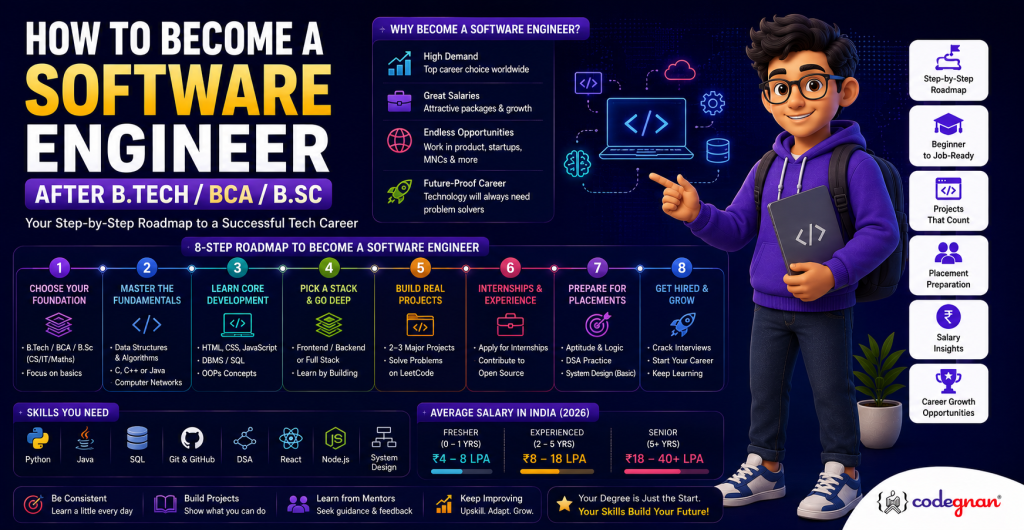
Software Engineer Roadmap After Graduation
This Software Engineer roadmap for freshers is designed to take you from zero coding experience to job-ready in a structured, step-by-step manner.
Step 1: Choose a Programming Language
Pick one language and get comfortable with it before jumping to another. Do not try to learn five languages at once.
- Java – widely used in enterprise applications and backend systems, and a common choice for campus placements.
- Python – beginner-friendly, versatile, and useful for web development, automation, and AI/ML.
- C++ – strong for competitive programming and understanding memory management.
- JavaScript – essential if you want to move into full stack or frontend development.
If you are unsure where to start, Python is often recommended as the best first language because of its simple syntax and wide industry demand.
Step 2: Learn Computer Science Fundamentals
These fundamentals form the backbone of every technical interview and every real-world engineering decision you will make.
- Data Structures – arrays, linked lists, stacks, queues, trees, and graphs.
- Algorithms – sorting, searching, recursion, and dynamic programming.
- OOP (Object-Oriented Programming) – classes, objects, inheritance, and polymorphism.
- Operating Systems – processes, threads, memory management, and scheduling.
- DBMS – normalization, transactions, and indexing.
- Computer Networks – the OSI model, TCP/IP, and how the internet actually works.
Step 3: Learn SQL & Databases
Almost every application needs to store and retrieve data, which makes databases non-negotiable for any Software Engineer career path.
- MySQL – the most common relational database taught and used in the industry.
- PostgreSQL – a powerful, open-source alternative favored by many product companies.
- MongoDB – a NoSQL database useful for flexible, document-based data.
Step 4: Master Git & GitHub
Version control is not optional. Learn to create repositories, commit changes, work with branches, resolve merge conflicts, and raise pull requests. A well-maintained GitHub profile also acts as proof of your coding activity when recruiters review your resume.
Step 5: Choose a Career Path
Once your fundamentals are solid, pick a specialization that matches your interests and the kind of roles you want to target.
Full Stack Development Covers both frontend and backend, making you capable of building complete applications end to end. This is one of the most in-demand specializations right now, which is why programs like Codegnan’s Python Full Stack Developer course focus heavily on real project work.
Backend Development Focuses on servers, APIs, databases, and business logic using languages like Java, Python, or Node.js.
Frontend Development Focuses on building user interfaces with HTML, CSS, JavaScript, and frameworks like React.
Mobile Development Covers building Android or iOS apps using Kotlin, Swift, or cross-platform tools like Flutter and React Native.
AI & Machine Learning Involves Python, statistics, and ML libraries to build predictive models and intelligent systems.
DevOps Focuses on CI/CD pipelines, containerization, and cloud infrastructure to help teams ship software faster and more reliably.
Step 6: Build Real-World Projects
Projects are what separate a candidate who “learned” a skill from one who can actually apply it. Aim to build at least three to five projects that solve real problems, not just tutorial clones.
Step 7: Learn System Design
Once you are comfortable with the basics, start learning how large systems are designed, including load balancing, caching, database sharding, and microservices. System design knowledge becomes especially important once you move beyond entry-level roles.
Step 8: Cloud & DevOps Basics
Learn the fundamentals of at least one cloud platform (AWS, Azure, or GCP), along with basic Docker and CI/CD concepts. Even a basic understanding of cloud deployment gives you a real edge over other freshers.
Step 9: Build a Portfolio
Put your best projects, resume, and contact details on a simple personal website or a well-organized GitHub profile. A portfolio gives recruiters a single place to evaluate your actual work.
Step 10: Prepare for Interviews
Interview preparation should run parallel to your learning, not start only after you finish everything. Practice coding problems consistently and revisit core concepts every few weeks.
Roadmap by Degree
While the core roadmap stays the same, the starting point and pace can differ depending on your degree background.
B.Tech Graduates
If you studied CSE or IT, you likely already have exposure to programming and core subjects. Focus your energy on projects, DSA practice, and interview preparation rather than relearning basics from scratch.
BCA Graduates
BCA gives you a solid foundation in programming and databases. To become a Software Engineer after BCA, strengthen your DSA skills, pick a specialization such as full stack development, and build projects that show practical application of what you learned in college.
B.Sc Graduates
B.Sc graduates, especially from Computer Science or related streams, usually need a bit more structured guidance around real-world development tools and frameworks. A focused software engineering course can help bridge this gap quickly with hands-on, industry-aligned training.
| Degree | Focus Areas | Suggested Learning Path |
|---|---|---|
| B.Tech | DSA, projects, interview prep | Strengthen fundamentals, build 3-5 projects, focus on system design |
| BCA | Programming depth, specialization | Pick full stack or backend, practice DSA, build a strong GitHub profile |
| B.Sc | Practical tools, frameworks, project exposure | Structured course, hands-on projects, resume and portfolio building |
Skills Required to Become a Software Engineer
Understanding the skills required for Software Engineer roles helps you prioritize your learning instead of trying to cover everything at once.
Programming Languages Java, Python, C++, or JavaScript, depending on your chosen specialization.
Frameworks Spring Boot for Java, Django or Flask for Python, React or Angular for frontend, and Node.js for backend JavaScript development.
Databases MySQL, PostgreSQL, and MongoDB, along with a basic understanding of database design.
Cloud Familiarity with AWS, Azure, or GCP fundamentals, including deployment and basic infrastructure concepts.
Soft Skills Communication, problem-solving, teamwork, and the ability to explain your technical decisions clearly during interviews and stand-up meetings.
Best Programming Languages to Learn
Choosing among the best programming languages for Software Engineering depends on your goals, but this table gives a quick comparison for beginners.
| Language | Best For | Difficulty | Demand |
|---|---|---|---|
| Python | Web development, AI/ML, automation | Easy | Very High |
| Java | Enterprise applications, backend systems | Moderate | Very High |
| JavaScript | Frontend and full stack development | Easy to Moderate | Very High |
| C++ | Competitive programming, system-level work | Hard | High |
Best Software Engineering Projects
Working on the right Software Engineering projects at each level helps you build a portfolio that actually demonstrates growth.
Beginner A to-do list app, a simple calculator, or a basic blog application using a single language and minimal external tools.
Intermediate An e-commerce website with authentication and a database, a weather app using a public API, or a chat application with real-time updates.
Advanced A full stack application with role-based access control, a food delivery or booking platform with payment integration, or a project involving basic machine learning predictions deployed on the cloud.
Internship & Placement Strategy
Getting your first opportunity often matters more than waiting for the “perfect” one, so keep multiple channels open at the same time.
Off-Campus Jobs Apply directly through company career pages and job portals, and do not wait only for campus drives, especially if you are from a BCA or B.Sc background where on-campus hiring may be limited.
Campus Placements If your college offers placement drives, prepare early with mock interviews and aptitude practice so you are ready when recruiters visit.
Open Source Contributions Contributing to open-source projects on GitHub builds real collaboration experience and often gets noticed by recruiters and hiring managers.
Freelancing Platforms like Upwork or Fiverr let you build real client experience, which strengthens your resume even before your first full-time job.
Resume, GitHub & LinkedIn Guide
Your resume should be one page, focused on projects and measurable outcomes rather than a long list of tools you have only briefly touched. Your GitHub should have a handful of well-documented repositories rather than dozens of half-finished ones. Your LinkedIn profile should clearly state your target role, list your key skills, and be updated regularly with project posts or certifications, since recruiters actively search LinkedIn for candidates.
Software Engineer Interview Preparation
Software Engineer interview preparation usually covers four broad areas, and each deserves dedicated practice time.
DSA Practice problems on arrays, strings, trees, graphs, and dynamic programming regularly rather than cramming right before interviews.
Coding Rounds Get comfortable coding on a whiteboard or a shared online editor, and practice explaining your thought process out loud while solving problems.
System Design For entry to mid-level roles, expect basic system design questions around designing simple applications like a URL shortener or a rate limiter.
HR Interview Prepare clear answers about your background, strengths, career goals, and why you want to join that specific company.
Certifications Worth Pursuing
Certifications will not replace practical skills, but they do add credibility when paired with real project experience.
- AWS – Cloud Practitioner or Solutions Architect Associate for cloud fundamentals.
- Microsoft – Azure Fundamentals for those targeting Microsoft-stack companies.
- Google – Google Cloud certifications or the Google IT Automation certificate.
- Oracle – Java certifications for developers focusing on the Java ecosystem.
- Meta – Front-End or Back-End Developer certificates for structured, project-based learning.
Software Engineer Salary in India
Software Engineer salary in India varies widely depending on your degree, company type, location, and skill set, so it helps to look at realistic ranges rather than a single number.
Salary by Degree Freshers from B.Tech, BCA, and B.Sc backgrounds generally start in a similar range at entry level, since most companies test skills through a coding round rather than filtering strictly by degree. B.Tech graduates from top-tier institutes may see slightly higher average offers, but strong BCA or B.Sc candidates with solid projects regularly match or beat those numbers.
Salary by Experience Freshers typically start between roughly 3 to 8 LPA depending on the company type, with IT services firms on the lower end and product companies or well-prepared campus hires on the higher end. Engineers with 2 to 5 years of experience often move into the 10 to 20 LPA range, while senior engineers with 5-plus years and strong system design skills can reach 25 to 50 LPA or higher at product companies.
Salary by Role Backend and full stack roles tend to command strong salaries across the board, while specialized roles in AI/ML, cloud architecture, and DevOps often pay a premium over generalist Software Developer roles once you have a few years of relevant experience.
Career Path
A typical Software Developer career progresses through the following stages, though titles and timelines vary by company.
- Intern – learning the codebase, tools, and team processes.
- Associate Software Engineer – handling smaller, well-defined tasks under guidance.
- Software Engineer – owning features end to end with growing independence.
- Senior Software Engineer – leading complex features and mentoring juniors.
- Staff Engineer – driving technical direction across multiple teams or projects.
- Engineering Manager – balancing people management with technical oversight.
Common Mistakes to Avoid
- Jumping between multiple programming languages before mastering one.
- Skipping Data Structures and Algorithms (DSA) because they seem too theoretical.
- Building only tutorial-based projects without adding your own features or improvements.
- Applying for jobs with a weak resume that doesn’t showcase real-world projects and practical skills.
- Waiting until you feel “fully ready” before starting interview preparation. Begin practicing early and improve as you learn.
Learning Timeline
A realistic Software Engineer learning path for beginners can look like this, though you should adjust the pace based on your current skill level.
3-Month Plan Learn one programming language thoroughly, cover basic data structures and algorithms, and build one small project.
6-Month Plan Add SQL and database concepts, learn Git and GitHub properly, pick a specialization like full stack development, and complete two to three solid projects.
12-Month Plan Deepen your DSA practice, learn basic system design and cloud fundamentals, complete an advanced project, build a strong resume and portfolio, and actively apply while preparing for interviews.
If you want this timeline compressed with expert mentorship and placement support, a structured Full Stack Developer course can help you move through these stages faster and with less trial and error.
FAQs
1. Can I become a Software Engineer after B.Tech?
Yes. B.Tech graduates, especially from CSE or IT streams, are well-positioned to become Software Engineers, though building strong DSA skills and real projects still matters more than the degree alone.
2. Can BCA graduates get Software Engineer jobs?
Yes. BCA graduates regularly get hired as Software Engineers when they pair their degree with strong programming skills, projects, and a chosen specialization such as full stack or backend development.
3. Is a B.Sc degree enough to become a Software Engineer?
Yes, a B.Sc degree, particularly in Computer Science, is enough as long as you build practical coding skills, complete real projects, and prepare properly for technical interviews.
4. Which programming language should I learn first?
Python is often recommended for beginners due to its simple syntax, though Java and JavaScript are also strong first choices depending on your target career path.
5. What skills are required to become a Software Engineer?
Core skills include a programming language, data structures and algorithms, databases, Git and GitHub, and at least one framework related to your chosen specialization.
6. How long does it take to become job-ready?
With consistent effort, most beginners can become job-ready in 6 to 12 months, though a focused, structured course can help shorten this timeline.
7. Do I need certifications to become a Software Engineer?
Certifications are not mandatory, but they can strengthen your resume when combined with real project experience and demonstrated coding skills.
8. What projects should I build for my resume?
Start with beginner projects like a to-do app, move to intermediate projects like an e-commerce site, and aim for at least one advanced project involving a full stack application or an API integration.
9. What is the average Software Engineer salary after graduation?
Freshers in India typically start in the range of roughly 3 to 8 LPA, depending on the company type, location, and the strength of their skills and projects.
10. How do I prepare for Software Engineer interviews?
Practice DSA problems consistently, build and be ready to explain your projects in detail, review core CS fundamentals, and take mock interviews to get comfortable with the format before the real thing.