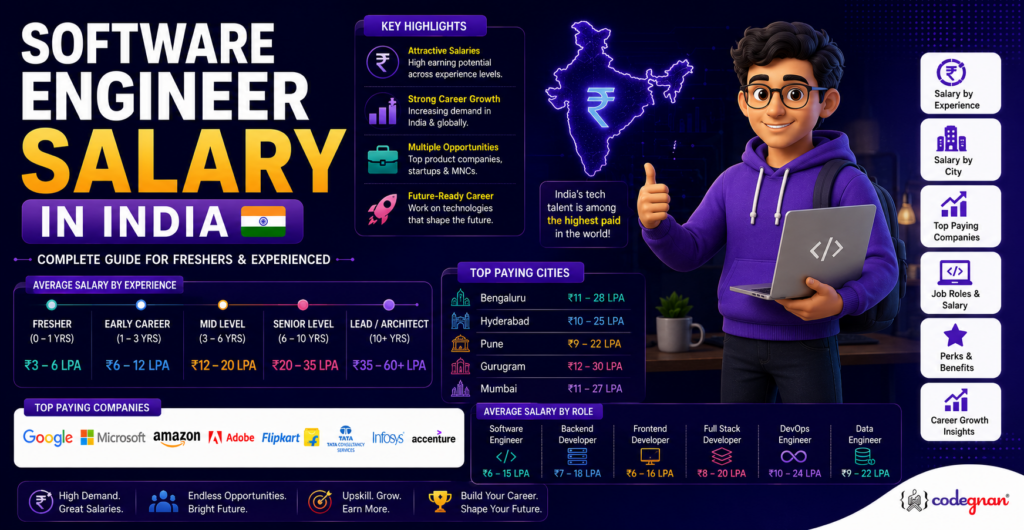





Quick Answer: The average Software Engineer salary in India in 2026 is around ₹8–12 LPA, with a typical range of ₹3.5 LPA for freshers at service companies to ₹40 LPA+ for senior engineers at product firms. Company type, city, and skills like AI, cloud, and system design drive the biggest pay differences.
Software engineering remains one of India’s most in-demand and highest-paying career paths in 2026. With the IT industry pushing toward $300 billion in revenue and AI, cloud computing, and product engineering reshaping hiring, understanding where you stand and where you can go matters more than ever. This guide breaks down the software engineer salary in India by experience, city, company, skill, and role, so you can benchmark your pay and plan your next move. If you’re just starting out, Codegnan’s Java Full Stack and Python programs are built to get you job-ready for these exact roles.
Software Engineer Salary in India 2026
Salary at a Glance
Software engineer pay in India in 2026 varies enormously depending on who’s hiring. Multiple industry salary surveys converge on a similar picture: a wide band stretching from roughly ₹3.5 LPA at entry-level service companies to well over ₹1 crore at FAANG and top product firms, once bonuses, ESOPs, and RSUs are included.
Average Salary
Across all experience levels, the average software engineer salary in India sits somewhere between ₹8 LPA and ₹12 LPA, translating to a monthly take-home of roughly ₹50,000–₹75,000 for a typical mid-career engineer. This average pulls together everything from fresher offers at IT services firms to senior architect-level pay at MNCs, so it’s best used as a broad reference point rather than a personal target.
Median Salary
The median, the figure that better represents what a “typical” engineer earns since it isn’t skewed by a small number of very high FAANG salaries, hovers around ₹9–10 LPA nationally. Half of all working software engineers in India earn below this figure, and half earn above it.
Salary Range
The full spread runs from about ₹3.5 LPA (fresher, Tier-2 or smaller service company) to ₹50 LPA+ (senior engineer, top product company or GCC), with outliers at FAANG and well-funded startups crossing ₹1 crore total compensation through equity. The gap between the 25th and 75th percentile at the fresher level alone can be as wide as 6–8x, which shows just how much company type and skillset matter from day one.
Software Engineer Salary by Experience
Experience remains the single strongest predictor of salary, but the rate of growth isn’t linear. The steepest jumps typically happen around the 2-year and 5-year marks, when engineers move from execution-focused roles into ownership and architecture.
Fresher (0–1 Year)
Fresh graduates typically earn ₹3.5–7 LPA at IT services companies (TCS, Infosys, Wipro) and ₹6–12 LPA at product companies and funded startups. Premier institute graduates hired through campus placement at top product firms can land ₹15–25 LPA, though this represents a small fraction of total fresher hires. If you’re preparing for this stage, a structured, project-heavy program like Codegnan’s Full Stack Developer course can meaningfully improve your starting offer by building the practical skills recruiters actually test for.
Junior (1–3 Years)
With a year or two of hands-on experience, engineers move into the ₹6–14 LPA range. This is also when engineers who’ve picked up in-demand frameworks, cloud basics, or a strong GitHub portfolio start pulling ahead of peers who stayed purely academic.
Mid-Level (3–5 Years)
Mid-level software engineers in India typically earn ₹10–22 LPA, with product companies and Global Capability Centers (GCCs) paying toward the higher end. This stage usually comes with backend ownership, code review responsibilities, and the first real exposure to system design interviews.
Senior (5–8 Years)
Senior engineer salaries generally fall between ₹18–40 LPA, and can go higher at top-tier product companies. Strong system design skills, cross-team collaboration, and the ability to mentor junior engineers become the deciding factors between a ₹20 LPA offer and a ₹35 LPA one.
Lead Engineer (8–12 Years)
Lead and staff-track engineers with deep technical ownership over a product area typically command ₹35–60 LPA. At this stage, compensation structure shifts, and a larger share comes from bonuses and equity rather than fixed base pay.
Principal/Staff Engineer (12+ Years)
Principal and staff engineers, particularly at global product companies and FAANG India centers, can see total compensation from ₹60 LPA to well over ₹1 crore, driven heavily by RSU vesting and performance bonuses.
| Experience | Average Salary | Top Product Companies |
|---|---|---|
| Fresher (0–1 yr) | ₹4–12 LPA | ₹15–25 LPA |
| Junior (1–3 yrs) | ₹6–14 LPA | ₹18–28 LPA |
| Mid-Level (3–5 yrs) | ₹10–22 LPA | ₹25–40 LPA |
| Senior (5–8 yrs) | ₹18–40 LPA | ₹40–60 LPA |
| Lead (8–12 yrs) | ₹35–60 LPA | ₹60–90 LPA |
| Principal/Staff (12+ yrs) | ₹60 LPA–1 Cr+ | ₹1 Cr+ |
Software Engineer Salary by Company Type
Company type is arguably a bigger salary lever than experience alone. The same engineer, with the same skillset, can see a 2–5x difference in pay simply by switching from a services firm to a product company.
Service Companies
IT services giants like TCS, Infosys, and Wipro pay ₹3.5–25 LPA depending on experience, with increments historically more conservative (5–7% annually) and salary bands capped tightly relative to product firms. They remain, however, the largest source of first jobs for engineering graduates in India.
Product Companies
Product-based companies pay 40–120% more than service firms for comparable experience, since engineers here directly influence revenue and user growth rather than billing hours to a client.
Global Capability Centers (GCCs)
GCCs (the India engineering arms of global companies like Microsoft, Amazon, Google, Walmart, and Goldman Sachs) increasingly rival product company pay, especially in Hyderabad, Bangalore, and Pune, and often come with strong benefits and global mobility options.
Startups
Early and growth-stage startups vary widely. A Series A startup might offer a lower base with meaningful equity upside, while a Series C/D or unicorn can match, or beat, MNC base pay while adding ESOPs.
FAANG & Big Tech
FAANG and equivalent big tech firms in India offer the highest total compensation, frequently pushing senior-level packages past ₹60–80 LPA once RSUs are factored in, and can cross ₹1 crore for staff-plus levels.
| Company Type | Typical Salary Range |
|---|---|
| Service Companies | ₹3.5–25 LPA |
| Product Companies | ₹6–50 LPA |
| GCCs | ₹8–55 LPA |
| Startups | ₹6–45 LPA (+ ESOPs) |
| FAANG & Big Tech | ₹15 LPA–1 Cr+ |
Software Engineer Salary by City
Location still matters in 2026, though remote and hybrid roles at global companies are gradually narrowing city-based pay gaps.
Bangalore
Bangalore remains India’s highest-paying city for engineers, commanding roughly a 15–25% premium over other metros thanks to its density of SaaS firms, product startups, and MNC engineering hubs.
Hyderabad
Hyderabad has closed much of the gap with Bangalore, driven by large Microsoft, Amazon, Google, and Apple engineering centers, while offering a noticeably lower cost of living. Students training locally through Codegnan’s Hyderabad center benefit directly from this growing hiring ecosystem.
Pune
Pune trails Bangalore by around 10–15% but is a strong hub for product engineering and automotive-tech software roles, with a better cost-of-living ratio.
Chennai
Chennai offers solid pay for engineers, particularly in auto-tech, fintech, and legacy enterprise IT, typically running slightly below the top three metros.
Delhi NCR
Delhi NCR is competitive for fintech, e-commerce, and enterprise software roles, with pay broadly comparable to Pune and Chennai for mid-level engineers.
Mumbai
Mumbai pays well for engineers in fintech and BFSI-adjacent product companies, given the concentration of financial services headquartered there.
Noida
Noida, part of the broader Delhi NCR belt, houses several product and services companies and offers pay roughly in line with the NCR average.
Gurgaon
Gurgaon is a strong hub for GCCs, consulting-tech, and startups, with salaries generally tracking close to Delhi NCR and Mumbai bands.
| City | Average Salary |
|---|---|
| Bangalore | ₹10–35 LPA |
| Hyderabad | ₹9–30 LPA |
| Pune | ₹8–25 LPA |
| Chennai | ₹7–22 LPA |
| Delhi NCR | ₹8–25 LPA |
| Mumbai | ₹8–28 LPA |
| Noida | ₹7–22 LPA |
| Gurgaon | ₹8–25 LPA |
Software Engineer Salary by Skills
Skills increasingly outweigh pedigree in determining pay, especially past the 3–5 year mark.
Java
Java remains a backbone skill for enterprise and BFSI systems, commanding steady, reliable pay across service and product companies alike. Codegnan’s Java Full Stack syllabus covers the core and advanced Java skills employers consistently ask for.
Python
Python’s versatility across web development, automation, data science, and AI makes it one of the most in-demand and best-paying languages, especially when paired with data or ML skills.
JavaScript
JavaScript is foundational for nearly every web-facing role, and strong JavaScript fundamentals (plus a modern framework) are non-negotiable for full-stack and frontend positions.
React
React remains the most requested frontend framework in Indian job postings, and proficiency here can meaningfully lift frontend and full-stack developer offers.
Node.js
Node.js skills open up backend and full-stack roles, particularly at startups and product companies building JavaScript-first stacks.
DevOps
DevOps engineers, especially those fluent in CI/CD pipelines and infrastructure automation, command a premium due to the operational risk they help mitigate.
Cloud
Cloud-native skills (AWS, GCP, Azure) can add a 20–30% premium over generalist profiles, as nearly every product company now runs cloud-first infrastructure.
AI & Machine Learning
AI/ML and generative AI expertise currently command some of the steepest premiums in the market, often 30–50% above generalist software engineering pay for comparable experience.
Data Engineering
Data engineers who can build and maintain large-scale pipelines are in high demand as companies scale their AI and analytics ambitions, pushing pay well above traditional backend roles.
| Skill | Salary Impact |
|---|---|
| Java | Baseline to +10% |
| Python | +10–20% |
| JavaScript/React | +10–15% |
| Node.js | +10–15% |
| DevOps | +15–25% |
| Cloud (AWS/GCP/Azure) | +20–30% |
| AI & Machine Learning | +30–50% |
| Data Engineering | +25–40% |
Salary by Job Role
- Software Engineer: ₹6–20 LPA average, scaling with experience and company type
- Software Developer: Broadly similar to software engineer, often used interchangeably in India
- Full Stack Developer: ₹5–22 LPA, with strong demand across startups and product firms. See Codegnan’s Full Stack course fees and duration for a detailed breakdown of what’s covered
- Backend Developer: ₹6–24 LPA, higher at companies with complex distributed systems
- Frontend Developer: ₹5–20 LPA, with React/Angular expertise pushing pay up
- Mobile Developer: ₹6–22 LPA for Android/iOS/Flutter specialists
- DevOps Engineer: ₹8–28 LPA, reflecting the premium on infrastructure and automation skills
- AI Engineer: ₹10–35 LPA, among the fastest-growing pay bands in 2026
- ML Engineer: ₹10–32 LPA, closely tracking AI engineering roles
- Data Engineer: ₹8–28 LPA, rising quickly as companies build out AI-ready data infrastructure
Product Company vs Service Company Salary
| Factor | Product Company | Service Company |
|---|---|---|
| Starting Pay (Fresher) | ₹6–15 LPA | ₹3.5–7 LPA |
| Mid-Level Pay | ₹22–40 LPA | ₹14–26 LPA |
| Annual Increments | 8–12% (high performers) | 5–7% |
| Equity/ESOPs | Common at senior levels | Rare |
| Work Nature | Own product features, direct user impact | Client-billed projects, defined scope |
| Career Growth Speed | Faster, skill-driven | Slower, tenure-driven |
Salary by Education
- B.Tech: The most common entry route; salary outcomes depend heavily on college tier and internship/project experience rather than the degree alone
- M.Tech: Can command a modest premium for R&D-heavy or specialized roles, though the gap narrows quickly with real-world experience
- MCA: A strong, cost-effective route into software roles, with outcomes largely comparable to B.Tech graduates once skills are demonstrated
- BCA: Increasingly common as a starting point, especially when paired with a focused upskilling program before job hunting
- Self-Taught Developers: With a strong portfolio and demonstrable projects, self-taught and bootcamp-trained developers can land ₹8–18 LPA at product companies, proof that in 2026, verified skills often matter more than the degree on paper. This is exactly the gap Codegnan’s project-based Java and Python programs are designed to close.
Salary by Industry
- FinTech: Among the highest-paying sectors, given the complexity and regulatory stakes of financial software
- SaaS: Strong, product-driven pay with frequent equity components
- Healthcare: Growing fast, with digital health and health-tech platforms pushing pay upward
- E-commerce: Competitive pay, particularly for engineers handling scale and personalization systems
- Gaming: Niche but well-paying for engineers with real-time systems and graphics expertise
- EdTech: Solid mid-range pay, with strong hiring volume post-pandemic
- AI: Currently the fastest-growing and highest-premium industry vertical for software talent
Top-Paying Companies in India
Google, Microsoft, Amazon, Atlassian, Adobe, Salesforce, Uber, Walmart Global Tech, Oracle, and Intuit consistently rank among India’s highest-paying employers for software engineers, particularly at their Bangalore and Hyderabad engineering centers. Senior engineers at these companies frequently see total compensation (base plus bonus plus RSUs) cross ₹40–80 LPA, with select senior and staff roles exceeding ₹1 crore.
Highest Paying Skills in 2026
AI Engineering, Generative AI, Cloud Computing, System Design, Kubernetes, Cybersecurity, and Data Engineering represent the highest-premium skills in today’s market. Engineers who combine strong fundamentals (DSA, system design) with one of these specializations are consistently the ones landing offers at the top end of every salary band listed above.
Salary Growth Roadmap
| Experience | Typical Growth |
|---|---|
| 0–2 years | Establish fundamentals; modest 8–12% annual hikes |
| 2–5 years | Steepest growth phase; job switches can bring 30–50% jumps |
| 5–8 years | Growth from technical depth and system design ownership |
| 8–12 years | Growth shifts toward leadership scope and equity |
| 12+ years | Growth driven by scale of impact, RSUs, and org-level ownership |
How to Increase Your Salary
Learn In-Demand Skills: Prioritize cloud, AI/ML, and system design, since these consistently carry the highest salary premiums in 2026.
Build Projects: A portfolio of real, deployed projects does more for your offer than a long list of completed courses.
Master DSA: Data structures and algorithms remain the gatekeeper for product company interviews, regardless of how experienced you are.
System Design: Beyond 3 years of experience, system design ability is often the single biggest differentiator between offers.
Open Source: Contributing to open-source projects builds credibility and visibility with hiring managers at product companies.
Certifications: Cloud and AI certifications (AWS, GCP, Azure, and applied ML credentials) can meaningfully strengthen a resume, especially for career switchers.
Job Switching Strategy: Since the steepest pay jumps in India’s tech market come from switching companies rather than internal raises, timing a move every 2–3 years (once genuinely ready) tends to accelerate salary growth.
Salary Negotiation Tips: Always negotiate against multiple offers where possible, research company-specific bands before the call, and remember that total compensation, not just base pay, is what should be compared across offers.
Structured, mentor-led training accelerates all of the above. Codegnan’s LaunchPad program combines project-based learning with mock interviews and placement support to help you move through this roadmap faster.
Software Engineer Career Path
The typical career path for a software engineer in India runs: Intern → Associate Software Engineer → Software Engineer → Senior Software Engineer → Staff Engineer → Principal Engineer → Engineering Manager. Not every engineer follows a management track. Many stay on the technical (IC) ladder through staff and principal levels, which at top product companies can match or exceed managerial pay.
Future Salary Trends
AI Impact: AI is reshaping which skills command premiums, with generative AI and applied ML experience increasingly separating top offers from average ones, even for engineers outside dedicated AI roles.
Remote Jobs: Remote roles at global product companies increasingly mirror the hiring company’s home salary band, making metro-equivalent pay more accessible from Tier-2 cities.
Global Hiring: Indian engineers are increasingly hired directly onto global teams, which is gradually pulling senior-level compensation closer to international benchmarks.
GCC Expansion: The continued expansion of Global Capability Centers in Hyderabad, Bangalore, and Pune is one of the biggest structural forces pushing average software engineer pay upward across India.
FAQs
1. What is the average Software Engineer salary in India in 2026?
The average software engineer salary in India in 2026 is roughly ₹8–12 LPA across all experience levels, though it varies significantly by company type, city, and skillset.
2. What is the salary of a fresher Software Engineer in India?
Freshers typically earn ₹3.5–7 LPA at IT services companies and ₹6–12 LPA at product companies and startups, with top campus offers occasionally reaching ₹15–25 LPA.
3. Which city pays Software Engineers the highest salary?
Bangalore pays the highest on average, followed closely by Hyderabad and Pune, largely due to the concentration of product companies and GCCs in these cities.
4. Which companies offer the best Software Engineer salaries?
Global product companies and FAANG firms such as Google, Microsoft, Amazon, Adobe, and Salesforce typically offer the highest total compensation in India.
5. How does experience affect Software Engineer salaries?
Salary rises steadily with experience, with the steepest jumps occurring around the 2-year and 5-year marks as engineers move into ownership and system design responsibilities.
6. Which skills can increase a Software Engineer’s salary?
AI/ML, cloud computing, DevOps, and system design consistently carry the highest salary premiums, often adding 20–50% over generalist pay.
7. What is the difference between product company and service company salaries?
Product companies typically pay 40–120% more than service companies for comparable experience, along with faster increments and more common equity components.
8. Is Software Engineering a high-paying career in India?
Yes, software engineering remains one of India’s highest-paying career paths, with strong long-term growth potential, especially for engineers who continuously upskill.
9. How can I negotiate a better Software Engineer salary?
Compare total compensation (not just base pay) across multiple offers, research company-specific salary bands in advance, and time negotiations around genuine market leverage such as a competing offer.
10. What is the highest salary a Software Engineer can earn in India?
At the senior and staff levels in FAANG or top product companies, total compensation can exceed ₹1 crore per year once bonuses and RSUs are included, though base salaries at India-based firms typically top out around ₹50–60 LPA.
Ready to build the skills that move you into the higher salary bands? Explore Codegnan’s Java Full Stack, Python, and Full Stack Developer programs, available across Hyderabad, Bangalore, and online, with 100% placement support to help you land your next offer.