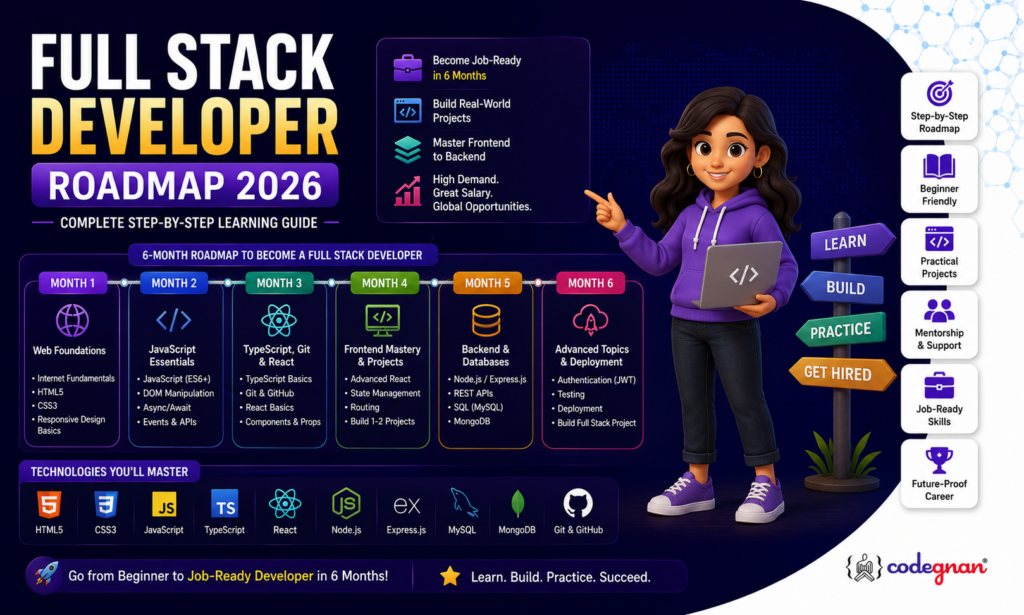





A full stack developer roadmap in 2026 covers internet basics, HTML5, CSS3, JavaScript, TypeScript, a frontend framework like React or Next.js, Git, a backend language such as Node.js, Java, or Python, databases, REST APIs, authentication, DevOps basics, cloud platforms, testing, and deployment. Most learners with consistent daily practice become job ready in four to eight months.
Full stack development remains one of the most in-demand and flexible career paths in tech. A single developer who can build the interface, write the server logic, design the database, and ship the application to production is more valuable to lean teams than ever, especially as companies lean on AI tools to move faster and expect their engineers to own more of the pipeline. This guide walks through exactly what to learn, in what order, and why, so you can build a realistic full stack developer roadmap for 2026 instead of guessing your way through scattered tutorials.
If you are comparing structured programs instead of self-teaching, Codegnan’s Full Stack Course in Hyderabad and Full Stack Course in Vijayawada follow this same roadmap with mentor-led projects and placement support.
What Is a Full Stack Developer?
A full stack developer builds and maintains both the client-facing part of an application (the frontend) and the server-side logic, database, and infrastructure that power it (the backend). Instead of specializing narrowly, a full stack developer understands how a request travels from a user’s browser, through an API, into a database, and back again as a rendered response.
Roles and Responsibilities
On a typical day, a full stack developer might design a database schema, build a REST API endpoint, style a React component, write unit tests, debug a production issue, and push a deployment through a CI/CD pipeline. The role varies by company size. At a startup, a full stack developer often owns a feature end to end. At a larger company, the same developer might work within a more defined slice of the stack while still understanding the full picture well enough to collaborate across teams.
Frontend vs Backend vs Full Stack
Frontend developers focus on what users see and interact with: layout, styling, interactivity, and performance in the browser. Backend developers focus on servers, databases, business logic, and security. A full stack developer sits across both, which is why the learning path is longer but also why the role offers more flexibility in the job market. If you are trying to decide between specializing early or going full stack, Codegnan’s comparison of React vs Angular is a useful starting point for understanding frontend-specific tradeoffs before you commit to a stack.
Skills Required
At a minimum, a job-ready full stack developer in 2026 needs solid HTML, CSS, and JavaScript fundamentals, working knowledge of a frontend framework, comfort with at least one backend language and framework, database design basics, REST API design, authentication concepts, Git version control, and enough DevOps and cloud knowledge to deploy an application without help. Employers increasingly also expect familiarity with AI coding assistants and basic prompt-based debugging, since these tools are now a normal part of the developer workflow rather than a novelty.
Why Become a Full Stack Developer in 2026?
Career Opportunities
Full stack roles appear across nearly every industry now, not just pure tech companies. Banks, healthcare platforms, logistics firms, and e-commerce companies all hire full stack developers because most modern products are, at their core, web or mobile applications backed by APIs and databases. This breadth means a full stack developer is rarely limited to one type of company or one region.
Salary Trends
Compensation for full stack developers varies widely by experience, stack, and location, which is exactly why it is worth checking current numbers rather than relying on a single figure. In India, freshers typically start between roughly ₹3.5 and ₹6 LPA, junior developers with one to three years of experience move into the ₹5 to ₹9 LPA range, and mid-level developers with three to five years of experience often earn between ₹9 and ₹16 LPA, with senior developers and architects crossing ₹20 to ₹50 LPA depending on company type and city, according to Codegnan’s detailed Full Stack Developer Salary in India guide. Product companies and Global Capability Centers in cities like Bangalore, Hyderabad, and Pune consistently pay more than traditional IT services firms for the same experience level.
Globally, the picture is similarly wide. In the United States, staffing data for 2026 places the center of the market for a mid-senior full stack developer at a mid-market company between roughly $118,000 and $148,000, with compensation pushing toward $160,000 for developers skilled in Next.js and TypeScript or Python and React with AWS experience. In the United Kingdom, average base pay sits closer to £43,700, while markets like Singapore and Australia pay a further premium for senior talent. The consistent theme across every region is that cloud skills, system design ability, and a strong project portfolio move a developer’s pay well above the median for their experience band.
Job Market
Digital transformation, AI-driven product development, and the continued growth of remote hiring are keeping demand for full stack developers strong heading into 2026. Companies increasingly prefer developers who can move across the stack without heavy hand-holding, since that flexibility reduces handoff delays on small teams. AI coding assistants have changed how code gets written, but they have not removed the need for developers who understand architecture, can debug production issues, and can translate business requirements into working software.
Required Skills
Beyond the technical roadmap covered below, employers are increasingly screening for practical signals: a portfolio of deployed projects (not tutorial clones), comfort with Git and code review workflows, basic cloud deployment experience, and the ability to explain technical decisions clearly in an interview. Data structures and algorithms remain the gatekeeper for product company interviews, so they cannot be skipped even if your daily job rarely involves competitive programming.
Full Stack Developer Roadmap (Step-by-Step)
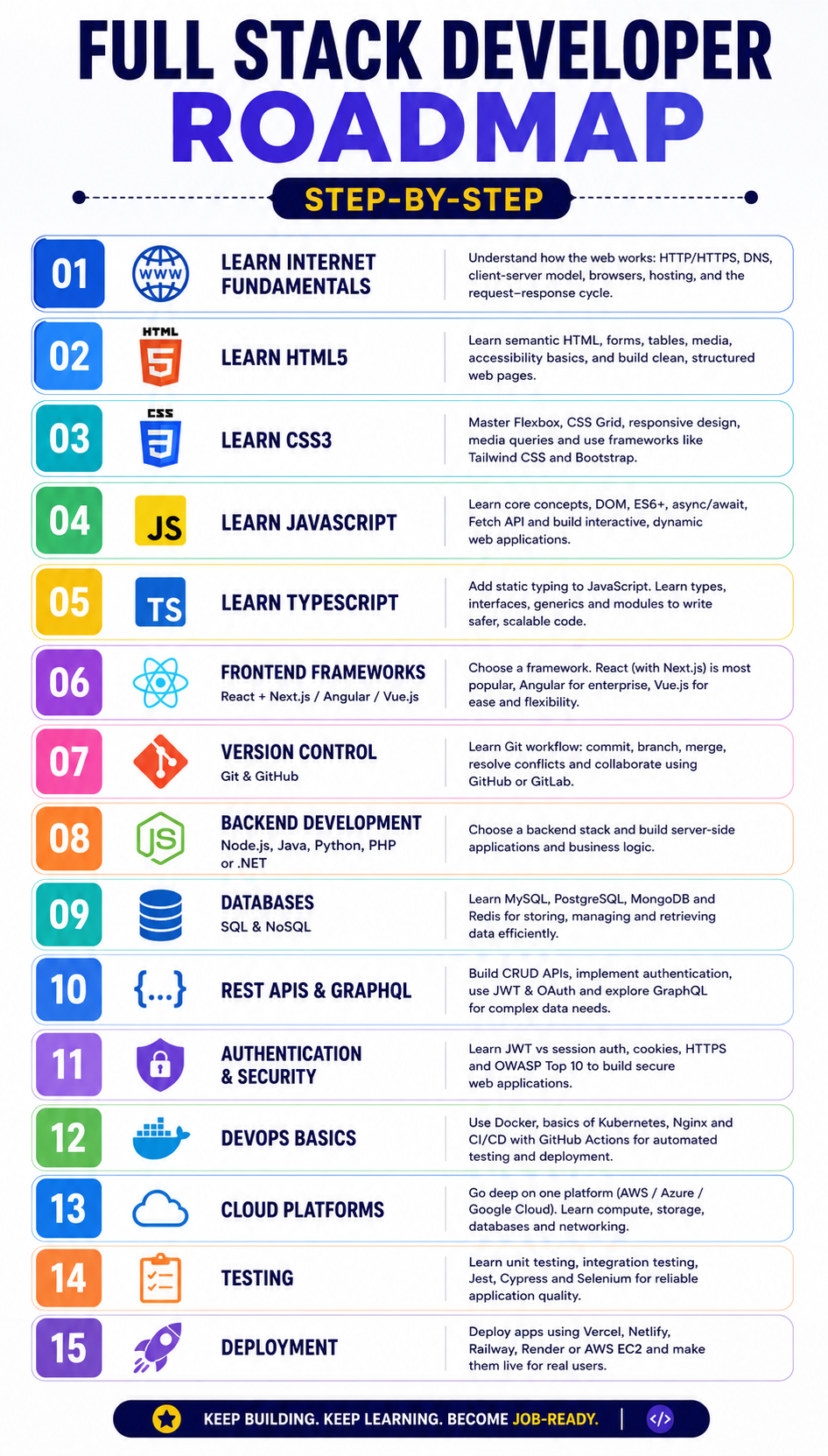
This is the core sequence. Each step builds on the one before it, so resist the urge to jump straight to a framework before the fundamentals are solid.
Step 1: Learn Internet Fundamentals
Before writing any code, understand how the web actually works. This means learning what happens when a browser requests a page, the difference between HTTP and HTTPS, how DNS resolves a domain name to a server, how browsers render pages, and what hosting actually means in practice. This step is often skipped by beginners, but it makes everything that follows, from APIs to deployment, far easier to reason about.
Step 2: Learn HTML5
HTML is the structural foundation of every web page. Focus on semantic HTML (using tags like header, nav, main, and article correctly instead of generic div soup), building accessible and well-structured forms, working with tables for tabular data, and understanding accessibility basics like alt text and proper heading hierarchy. Clean semantic HTML also helps with SEO and screen reader compatibility, which matters more to employers than many beginners expect.
Step 3: Learn CSS3
CSS controls layout and visual design. Modern CSS work centers on Flexbox for one-dimensional layouts and CSS Grid for two-dimensional layouts, along with responsive design techniques using media queries so applications work across phones, tablets, and desktops. Once the fundamentals are solid, utility frameworks like Tailwind CSS and component libraries built on Bootstrap speed up real-world development significantly, and most product teams now expect familiarity with at least one of them.
Step 4: Learn JavaScript
JavaScript is what makes a page interactive, and it is also the language most full stack developers use across both frontend and backend when working in a MERN or MEAN stack. Learn variables and scope, functions and closures, DOM manipulation, ES6+ features like arrow functions, destructuring, and modules, asynchronous programming with promises and async/await, and how to fetch data from an API using the Fetch API. This step is the longest and most important in the entire roadmap, since weak JavaScript fundamentals cause problems in every later step.
Step 5: Learn TypeScript
TypeScript adds static typing on top of JavaScript, and in 2026 it has moved from optional to effectively expected on most product teams, particularly for frontend and MERN-stack roles building large codebases. Learn basic types, interfaces, generics, and how TypeScript modules work. The upfront learning curve pays off quickly once you are working in a codebase with more than a handful of files, since TypeScript catches entire categories of bugs before code ever runs.
Step 6: Frontend Frameworks
With JavaScript and TypeScript fundamentals in place, move to a frontend framework. React remains the dominant choice for hiring and ecosystem depth, and in 2026 choosing React increasingly means choosing Next.js alongside it, since Next.js has become the default meta-framework for building full-stack React applications with server-side rendering, static generation, and edge functions built in. Angular remains strong in enterprise and government software where structure and predictability matter more than flexibility, and Vue continues to be popular with teams that want a gentler learning curve without sacrificing capability.
| Framework | Best For |
|---|---|
| React + Next.js | Full-stack products, startups, the widest hiring pool, SEO-friendly public pages |
| Angular | Large enterprise teams that need strict structure and long-term maintainability |
| Vue.js | Teams that want approachability and flexibility without enterprise-level complexity |
For a deeper side-by-side comparison before committing to a framework, see Codegnan’s breakdown of React vs Angular, and once you are ready to build, browse React JS project ideas to start applying what you have learned.
Step 7: Version Control
Git is non-negotiable for any developer, full stack or otherwise. Learn the core workflow: committing changes, branching, merging, resolving conflicts, and working with remote repositories. Then get comfortable with GitHub or GitLab for hosting code, opening pull requests, and collaborating through code review, since this is how nearly every real engineering team works day to day.
Step 8: Backend Development
This is where you choose a backend language and framework, and the choice shapes your entire specialization from this point forward.
- Node.js and Express.js: The natural pairing with a React or Next.js frontend, since it lets you write JavaScript or TypeScript across the entire stack. This is the backbone of the MERN and MEAN stacks.
- Java with Spring Boot: Dominant in banking, fintech, insurance, and large enterprise systems, and consistently one of the highest-paying full stack combinations in the Indian job market.
- Python with Django or Flask: Popular at startups and AI-driven product companies, especially valuable now because Python overlaps with data science and AI integration work.
- PHP with Laravel: Still widely used in existing enterprise systems and CMS-driven platforms, though less commonly chosen for new greenfield projects.
- .NET: A strong choice inside Microsoft-heavy enterprise environments.
If you are still deciding between Java and Python for your backend, Codegnan’s guides on how to become a Java Full Stack Developer and how to become a Python Full Stack Developer walk through the learning path and market positioning of each, and the Java Full Stack Developer course syllabus and Python Full Stack Developer course syllabus show exactly what a structured curriculum covers.
Step 9: Databases
Every backend needs somewhere to store data. Learn relational databases like MySQL and PostgreSQL for structured data with strict relationships, and NoSQL databases like MongoDB for flexible, document-based data models. Redis is worth learning separately as a fast in-memory store for caching and session management, since it shows up constantly in production systems that need to reduce database load.
| SQL (MySQL, PostgreSQL) | NoSQL (MongoDB) |
|---|---|
| Structured schema with defined relationships | Flexible, schema-less document structure |
| Strong consistency, ideal for transactions | Scales horizontally with ease |
| Best for financial data, inventory, structured records | Best for rapidly changing data, content, catalogs |
To practice these concepts with real project work, Codegnan’s list of Java project ideas and Python project ideas include database-driven builds you can use to strengthen this part of your portfolio.
Step 10: REST APIs and GraphQL
Once you can store and retrieve data, learn to expose it through an API. Build CRUD (Create, Read, Update, Delete) APIs, understand authentication patterns for protecting endpoints, and get comfortable with JWT (JSON Web Tokens) and OAuth for securing user sessions and third-party logins. GraphQL is worth learning at a basic level as an alternative to REST, particularly if you plan to work at a company with complex, deeply nested data requirements where over-fetching with REST becomes a real performance problem.
Step 11: Authentication and Security
Security is not optional, and it is one of the areas where junior developers most often fall short in interviews and on the job. Learn how JWT and session-based authentication differ, how cookies work in the context of authentication, why HTTPS matters for every production application, and the OWASP Top 10, which lists the most common and dangerous web application vulnerabilities. Even a basic working knowledge of these risks makes you noticeably more employable, since companies increasingly ask security-related questions in technical interviews.
Step 12: DevOps Basics
Full stack developers who understand deployment pipelines are far more valuable to smaller teams that lack a dedicated DevOps engineer. Learn Docker for containerizing applications, the basics of Kubernetes for orchestrating containers at scale, Nginx as a reverse proxy and web server, and CI/CD concepts using tools like GitHub Actions to automate testing and deployment whenever code is pushed. You do not need deep DevOps mastery, but hands-on comfort with these tools consistently separates candidates who get hired from those who only understand theory.
Step 13: Cloud Platforms
Pick one cloud platform and go deep rather than spreading yourself thin across all three. AWS remains the most widely used in industry and the safest default choice for job seekers, though Azure is strong in Microsoft-heavy enterprises and Google Cloud has a growing footprint in AI-focused companies. Learn the core services: compute (EC2 or equivalent), storage, managed databases, and basic networking and security groups.
Step 14: Testing
Untested code is a liability in any real production environment. Learn the difference between unit testing (testing individual functions or components in isolation) and integration testing (testing how different parts of the system work together). Jest is the standard choice for JavaScript and React unit testing, Cypress is widely used for end-to-end testing of full applications, and Selenium remains common for browser automation and cross-browser testing in larger enterprise QA pipelines. If testing interests you as a specialization, Codegnan’s Software Testing Course in Hyderabad covers this in far more depth.
Step 15: Deployment
The final step is getting your application in front of real users. Vercel and Netlify are the fastest options for deploying frontend applications and Next.js projects, with generous free tiers that make them ideal for portfolio projects. Railway and Render have become popular for deploying full stack applications with a backend and database attached, while AWS EC2 remains the standard for more complex, production-grade deployments where you need full control over infrastructure.
Full Stack Developer Roadmap Timeline
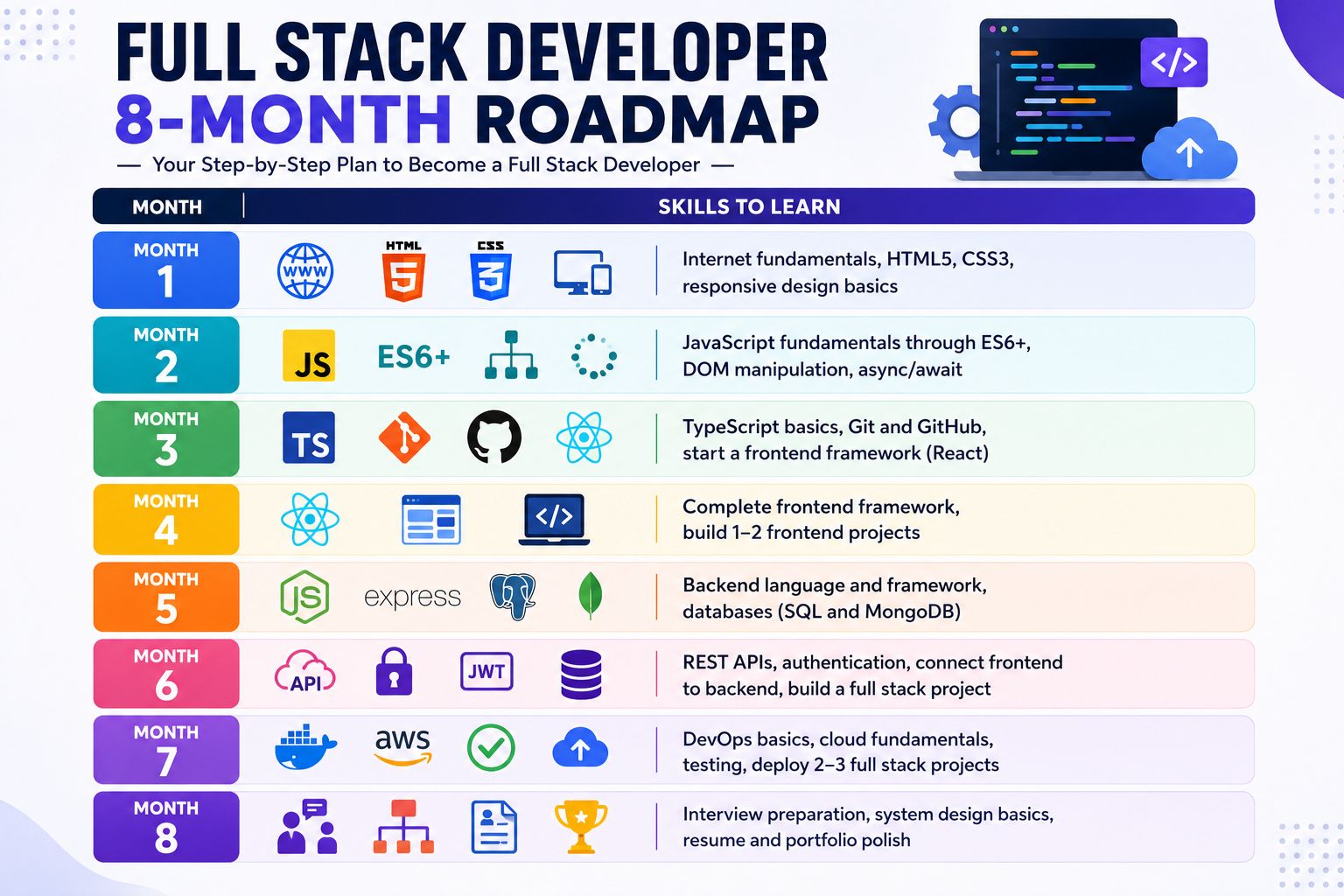
This eight-month timeline assumes consistent, near-daily practice. Learners with prior programming exposure often compress this into four to five months, while those starting from absolute zero may need closer to ten. Structured programs, including Codegnan’s Full Stack Developer course, typically run on a 100-day to four-month intensive schedule with mentor guidance, which tends to compress the self-taught timeline significantly because the sequencing and project scope are already designed for you. The Full Stack Developer course fees and duration guide breaks down exactly what that looks like across different formats.
MERN Stack Roadmap
MERN stands for MongoDB, Express.js, React, and Node.js, and it is the most popular stack for startups and product companies building fast, JavaScript-only applications. The roadmap sequence is: JavaScript and TypeScript fundamentals, React (paired with Next.js for most real projects in 2026), Node.js and Express.js for the backend, MongoDB for the database, and then REST API integration to connect the pieces. The biggest advantage of MERN is that you only need to be fluent in one language, JavaScript or TypeScript, across the entire stack, which shortens the learning curve considerably. Codegnan’s MERN Stack Training Course in Hyderabad and MERN Stack Training Course in Vijayawada follow this exact sequence.
MEAN Stack Roadmap
MEAN swaps React for Angular: MongoDB, Express.js, Angular, and Node.js. This stack is worth considering if you are drawn to Angular’s opinionated, structured approach, or if you are targeting enterprise employers that already standardize on Angular for internal tools and large-scale applications. The backend and database steps are identical to MERN; the difference is purely in the frontend framework and the architectural discipline Angular enforces.
Java Full Stack Roadmap
A Java full stack roadmap follows HTML, CSS, and JavaScript fundamentals, then moves into core Java, followed by Spring Boot for building backend APIs, paired with a frontend framework like React or Angular. Add SQL databases (commonly MySQL or PostgreSQL, given Java’s strength in structured enterprise data), REST API development with Spring, and basic DevOps and cloud skills. This path is generally the most in-demand for banking, fintech, and large enterprise roles in India, and it tends to carry the highest salary ceiling among the major stack combinations. Codegnan’s Java Full Stack Course in Hyderabad and Java Full Stack Course in Vijayawada are built around this exact roadmap, and the how to become a Java Full Stack Developer guide expands on the career trajectory in more detail.
Python Full Stack Roadmap
A Python full stack roadmap covers HTML, CSS, and JavaScript fundamentals, core Python, then Django or Flask for backend development, paired with React on the frontend. Because Python is the dominant language in data science and AI, developers who combine full stack skills with basic data handling or LLM API integration are seeing strong demand from startups building AI-powered products. Codegnan’s Python Full Stack Course in Hyderabad and Python Full Stack Course in Vijayawada follow this roadmap, and the how to become a Python Full Stack Developer guide covers the full career path.
Full Stack Projects
Projects are what separate a candidate who understands theory from one who can actually ship software. Recruiters can immediately tell the difference between a tutorial clone and a project that solves a real problem, uses a genuine database, and is deployed somewhere live.
Beginner Projects: A personal portfolio website, a to-do list application with full CRUD functionality, and a simple weather app that consumes a public API are good starting points that build core frontend and API-consumption skills.
Intermediate Projects: A blog CMS with user authentication and a comment system, a basic chat application using WebSockets, and a simple e-commerce storefront with a product catalog and cart introduce real backend complexity and database relationships.
Advanced Projects: A full e-commerce website with payment integration, a social media application with real-time notifications, a learning management system (LMS) with role-based access, a hospital management system handling multiple user types and records, and a job portal connecting employers and candidates all demonstrate the kind of end-to-end system design that senior interviewers look for.
Specific idea lists by language are available in Codegnan’s Java project ideas, Python project ideas, and React JS project ideas, each with enough detail to build something portfolio-worthy rather than another tutorial clone.
GitHub Portfolio Guide
A strong GitHub profile matters almost as much as the resume itself for full stack roles. Pin your three or four best projects rather than showing every small exercise. Write clear README files that explain what the project does, the tech stack used, and how to run it locally. Commit regularly with meaningful messages instead of a single massive commit, since recruiters and hiring managers do look at commit history to gauge real, incremental development work rather than a last-minute copy-paste. Deploy every significant project with a live link in the README, since a working demo consistently outperforms a static screenshot.
Full Stack Interview Preparation
Technical Questions typically cover core JavaScript concepts (closures, hoisting, the event loop), how your chosen frontend framework handles state and rendering, and backend concepts like middleware, request lifecycles, and database indexing.
Coding Questions focus on data structures and algorithms fundamentals, since this remains the gatekeeper for interviews at most product companies regardless of how strong your project portfolio is. Codegnan’s Java Interview Questions and Python Interview Questions collections are a good way to practice the exact style of questions asked in real interviews.
System Design Basics become increasingly important from the mid-level interview stage onward. Be ready to talk through how you would design a URL shortener, a rate limiter, or a basic notification system, focusing on tradeoffs rather than a single “correct” answer.
HR Questions are often underprepared for despite being straightforward: be ready to explain gaps in your resume honestly, describe a conflict you navigated on a team or project, and articulate clearly why you want the specific role and company you are interviewing with.
Full Stack Developer Resume Guide
Lead with a portfolio link and GitHub profile at the top of your resume, not buried at the bottom. List projects with specific, measurable outcomes where possible (for example, “built and deployed a full stack e-commerce app with JWT authentication and Stripe integration” rather than just “built an e-commerce app”). Keep the resume to one page for anyone under five years of experience, and tailor the listed skills to match the specific job description rather than sending an identical resume everywhere. Avoid listing every technology you have ever touched; a focused list of technologies you can confidently discuss in an interview is far more effective than an exhaustive one.
Certifications
Certifications are not a substitute for projects, but they can strengthen a resume, particularly for cloud and platform-specific skills. Worth considering are Meta’s Front-End and Back-End Developer certificates, Google’s IT Automation and Cloud certificates, Microsoft’s Azure Fundamentals certification, and AWS’s Certified Cloud Practitioner or Certified Developer Associate credentials. Treat certifications as a supplement to a strong project portfolio, not a replacement for one.
Best Resources to Learn
Free Courses: freeCodeCamp for structured, project-based fundamentals; The Odin Project for a full stack curriculum built around real projects.
YouTube Channels: Traversy Media and Web Dev Simplified are widely used for practical, up-to-date tutorials on frontend and full stack topics.
Books: “Eloquent JavaScript” for deep JavaScript fundamentals and “Designing Data-Intensive Applications” for developers ready to go deeper into backend architecture and system design.
Documentation: The official docs for React, Next.js, Node.js, and MDN Web Docs for HTML, CSS, and JavaScript reference remain the most reliable sources, since third-party tutorials frequently lag behind framework updates.
Common Mistakes Beginners Make
Jumping straight into a framework like React before JavaScript fundamentals are solid is the most common mistake, and it consistently shows up later as confusion that has nothing to do with React itself. Following tutorials passively without building anything independently is a close second; the skill that actually gets tested in interviews and on the job is building without a script to follow. Skipping Git and version control until “later” is another common trap, since it becomes far harder to learn once you are also juggling framework and backend complexity. Finally, many beginners try to learn every technology at once instead of going deep on one stack first, which slows progress far more than it helps.
Career Opportunities
A full stack skill set opens doors to several related roles beyond the “Full Stack Developer” title itself. Frontend Developer roles focus purely on the client side for those who discover they prefer UI and interaction design. Backend Developer roles suit those who gravitate toward system architecture, databases, and performance. Full Stack Developer and Software Engineer titles are often used interchangeably at many companies, particularly at startups. DevOps Engineer is a natural next step for full stack developers who develop a strong interest in infrastructure, deployment pipelines, and cloud architecture.
Full Stack Salary by Country
| Country | Average Salary (Approx., 2026) |
|---|---|
| India | ₹8-12 LPA average across experience levels; ₹3.5-6 LPA for freshers, ₹25-50 LPA+ for senior architects |
| United States | $118,000-$148,000 base for mid-senior developers, with $160,000+ for strong TypeScript, Next.js, or cloud-heavy stacks |
| United Kingdom | Approximately £43,700 average base salary |
| Singapore | Roughly $69,000-$124,000 depending on experience |
| Australia | Roughly $76,000-$113,000+ annually |
Salary figures vary significantly based on the source methodology, company type, and specific tech stack, so treat these as directional benchmarks. For a full breakdown specific to the Indian market by experience level, city, and stack, see Codegnan’s Full Stack Developer Salary in India guide.
Frequently Used Developer Tools
| Tool | Purpose |
|---|---|
| VS Code | Primary code editor for most full stack developers |
| GitHub Copilot / Cursor | AI-assisted coding and debugging |
| Postman | Testing and documenting REST APIs |
| Docker Desktop | Local containerization and environment consistency |
| Figma | Reviewing and implementing design handoffs |
| MongoDB Compass | Visual interface for managing MongoDB databases |
| AWS Console | Managing cloud infrastructure and deployments |
FAQs
What is a Full Stack Developer? A full stack developer is someone who can build both the frontend (what users see and interact with) and the backend (servers, databases, and business logic) of a web application, along with enough DevOps knowledge to deploy it.
How do I become a Full Stack Developer in 2026? Follow a structured roadmap: internet fundamentals, HTML, CSS, JavaScript, TypeScript, a frontend framework, Git, a backend language and framework, databases, REST APIs, authentication, DevOps basics, cloud fundamentals, testing, and deployment, then build and deploy several real projects and prepare for technical interviews.
Which programming language should I learn first? JavaScript is the most practical first language for full stack development, since it works across both frontend and backend in a MERN stack and has the largest beginner-friendly ecosystem. If you are targeting enterprise or banking roles specifically, starting with Java is also a strong choice.
Is MERN Stack better than Java Full Stack? Neither is universally better. MERN offers a shorter learning curve since it uses one language throughout and is favored by startups, while Java Full Stack tends to command higher salaries in enterprise, banking, and fintech roles in India. The right choice depends on the type of company you want to work for.
How long does it take to become a Full Stack Developer? With consistent daily practice, most learners reach job readiness in four to eight months. Structured programs with mentor guidance and defined projects often compress this timeline compared to self-teaching.
Which projects should I build to get a job? Build at least two to three deployed, end-to-end projects that go beyond tutorial clones, ideally including authentication, a real database, and a live deployment link, such as a blog CMS, an e-commerce site, or a job portal.
Do I need to learn DevOps as a Full Stack Developer? You do not need deep DevOps expertise, but basic comfort with Docker, CI/CD concepts, and deploying an application to the cloud makes you significantly more valuable, especially at smaller companies without a dedicated DevOps team.
What is the average Full Stack Developer salary? It varies widely by country, experience, and stack. In India, the average across all experience levels is roughly ₹8-12 LPA in 2026, while in the United States mid-senior developers typically earn between $118,000 and $148,000 base salary. See the full Full Stack Developer Salary in India guide for a detailed breakdown.
Is a computer science degree required? No. Skills, projects, and interview performance matter far more to most employers than the degree itself, though a degree can help at large, traditional companies with rigid hiring filters.
Which Full Stack technology stack has the highest demand? React paired with Next.js has the widest hiring pool globally, while Java Full Stack remains the highest-paying and most in-demand combination specifically within Indian banking, fintech, and enterprise hiring.
Ready to Start Your Full Stack Journey?
This roadmap gives you the full sequence, but following it alone, without structure, feedback, or accountability, is where most self-taught learners lose momentum. Codegnan has trained thousands of students across Java, Python, and full stack development with hands-on projects, mentor-led training, and placement support across hiring partners in Vijayawada, Hyderabad, and Visakhapatnam. Explore the Full Stack Developer course, the Java Full Stack course, or the Python Full Stack course to see the exact curriculum and project list behind this roadmap.